35 articles
From the Sun next door to galaxies billions of light-years away — space, astronomy, and humanity's journey beyond Earth.
Subtopics
Outer space is an extremely hostile environment for the human body. The absence of breathable air, near-zero atmospheric pressure, extreme temperatures, and hazardous radiation make it impossible for humans to survive for long without a protective suit.
By definition, a vacuum is a space nearly devoid of matter. Outer space is the largest known natural vacuum, characterized by an extremely low density of matter.
Alpha Centauri is the closest star system to the Solar System, located approximately 4.37 light-years away. It is a triple star system comprising Alpha Centauri A, Alpha Centauri B, and Alpha Centauri C (Proxima Centauri). Proxima Centauri, a small red dwarf in the outermost orbit, is the closest individual star to Earth, situated about 4.25 light-years away.
Pulsar timing arrays (PTAs) recently detected an ultra-low-frequency gravitational-wave background permeating the universe. A 2026 study suggests this signal may originate not only from merging supermassive black hole binaries, but could also contain signatures of giant "dark stars" that existed over 13 billion years ago. If confirmed, these gravitational waves could help reveal the origins of the universe's earliest supermassive black holes.
Barely heated or altered in 4.6 billion years, comets are the closest thing we have to the raw material the planets were built from — and Rosetta's in-situ data revised a good deal of what was believed about them.
What arrives from the Sun is energy; the light itself comes from oxygen atoms and nitrogen molecules high in the atmosphere after electrons strike them — and the lifetime of each excited state is why each altitude has its own colour.
A solar eclipse is the Moon's shadow sweeping across Earth; a lunar eclipse is the Moon entering Earth's shadow. That difference sets how wide the viewing zone is, how long it lasts, and whether eye protection is required.
No single method stands alone: parallax calibrates Cepheids, Cepheids calibrate Type Ia supernovae, and those calibrate the Hubble constant — which is why a disagreement at the top forces a re-check of every rung below.
It all began with a collapsing cloud of gas and dust 4.57 billion years ago. The hardest question is not how planets formed, but why the Sun holds 99.86% of the mass yet only 1% of the angular momentum.
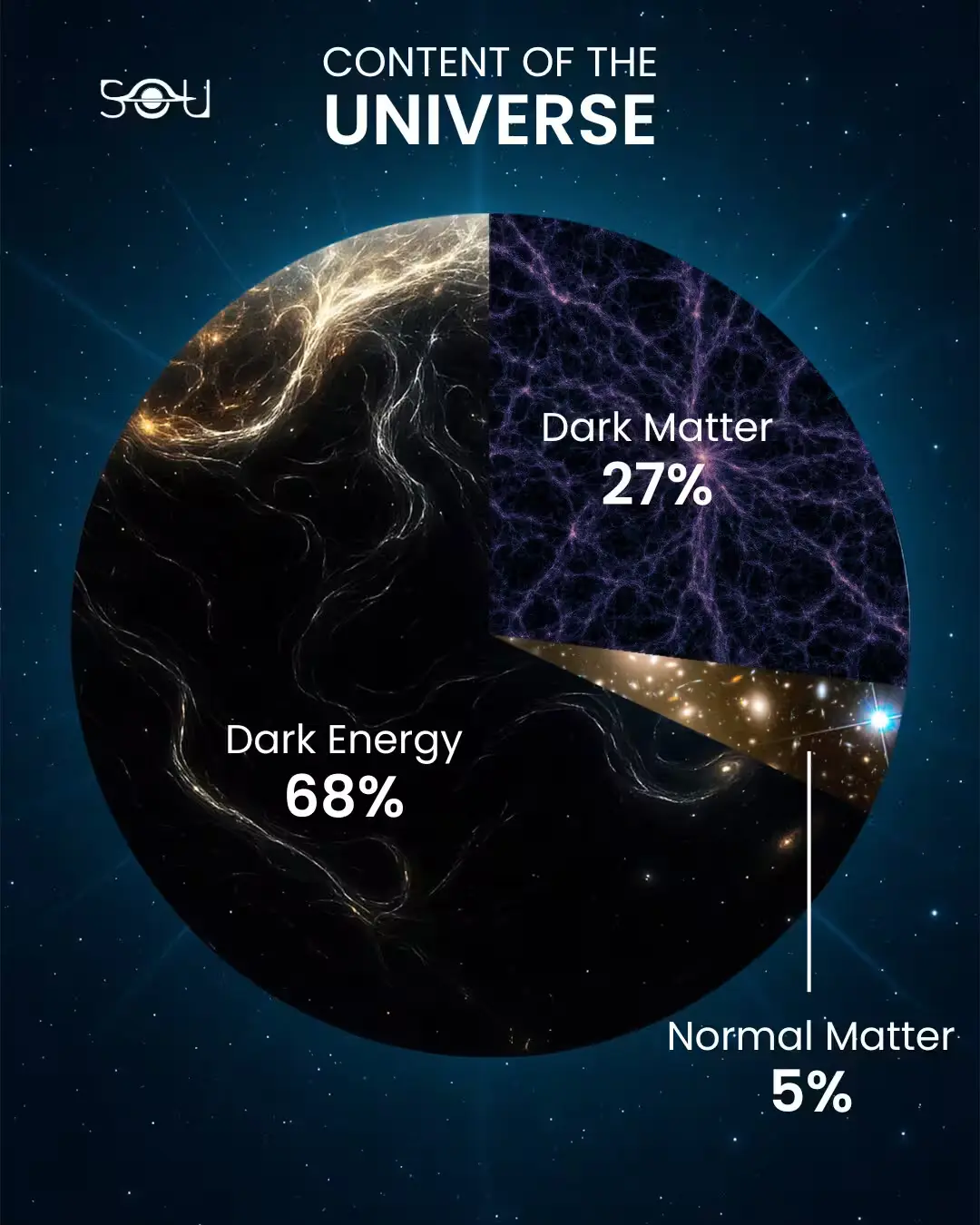
They share only the word "dark" and the fact that nobody has seen either. One pulls matter together, the other pushes space apart. Together they are 95% of the universe, and we do not know what either one is.
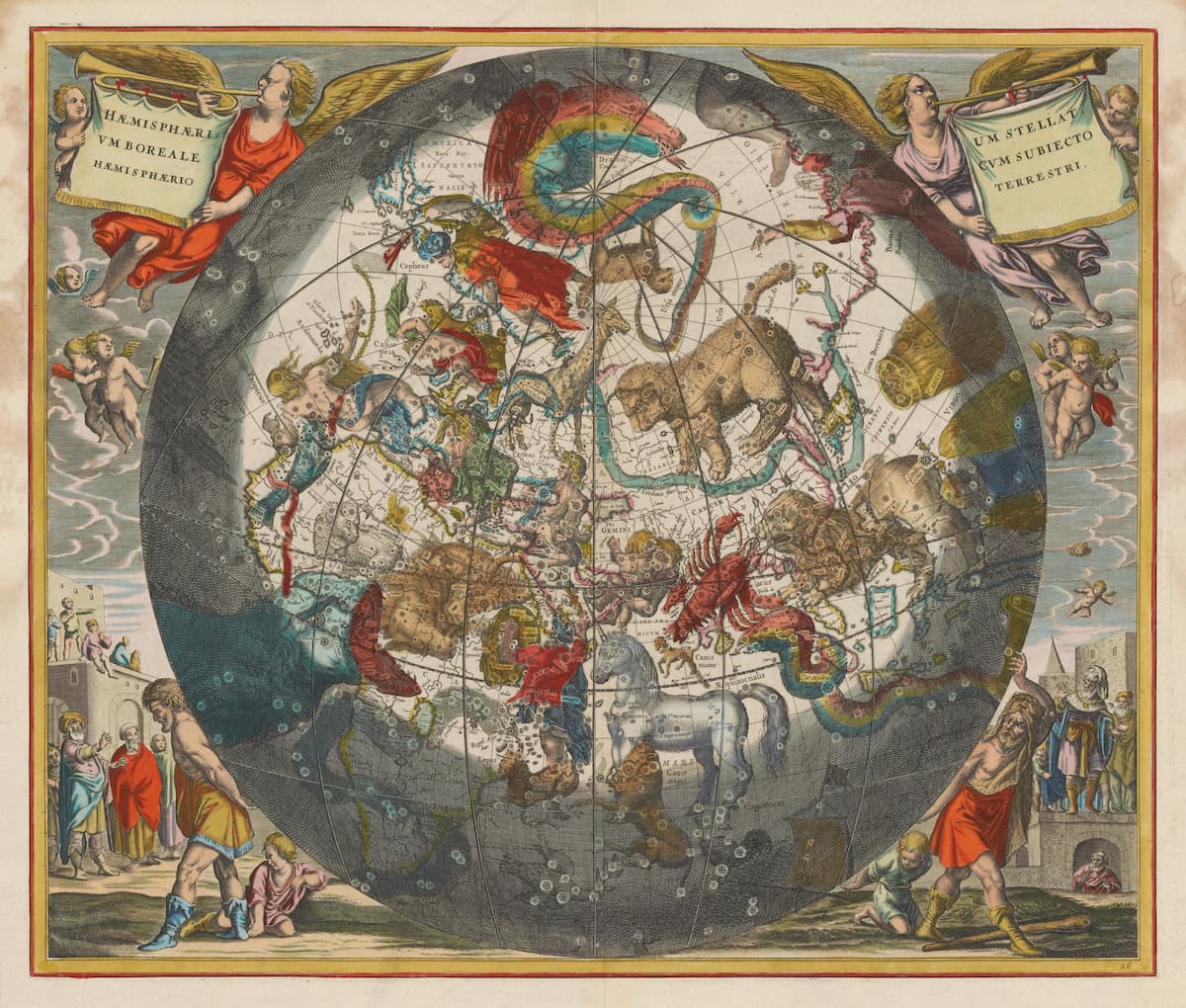
Not because it is old, nor because Earth's axis has shifted. The decisive reason is elsewhere: whenever it is tested double-blind, astrology performs no better than chance.
Not an explosion in space but the expansion of space itself. The timeline from 10⁻⁴³ seconds to today, the three pillars of evidence, and why the universe's fate was rewritten in 1998.