Contents
How Empty Is Outer Space?
Although not a perfect vacuum, the vast majority of the universe contains very few particles of matter.
On average, each cubic meter of space contains only about a few protons or atoms. This figure is much lower than any environment found on Earth.
Under the influence of gravity, matter gradually clusters into:
- Stars
- Planets
- Star systems
- Galaxies
leaving behind nearly empty regions between them called:
- Interplanetary space
- Interstellar space
- Intergalactic space
Why Is the Universe Nearly a Vacuum?
After the Big Bang, matter was distributed relatively evenly throughout space.
Over billions of years, gravity pulled matter together into increasingly larger structures such as galaxies and galaxy clusters. As matter aggregated, the space in between became increasingly sparse.
Consequently, the majority of the universe's volume today consists of regions with extremely low matter density.
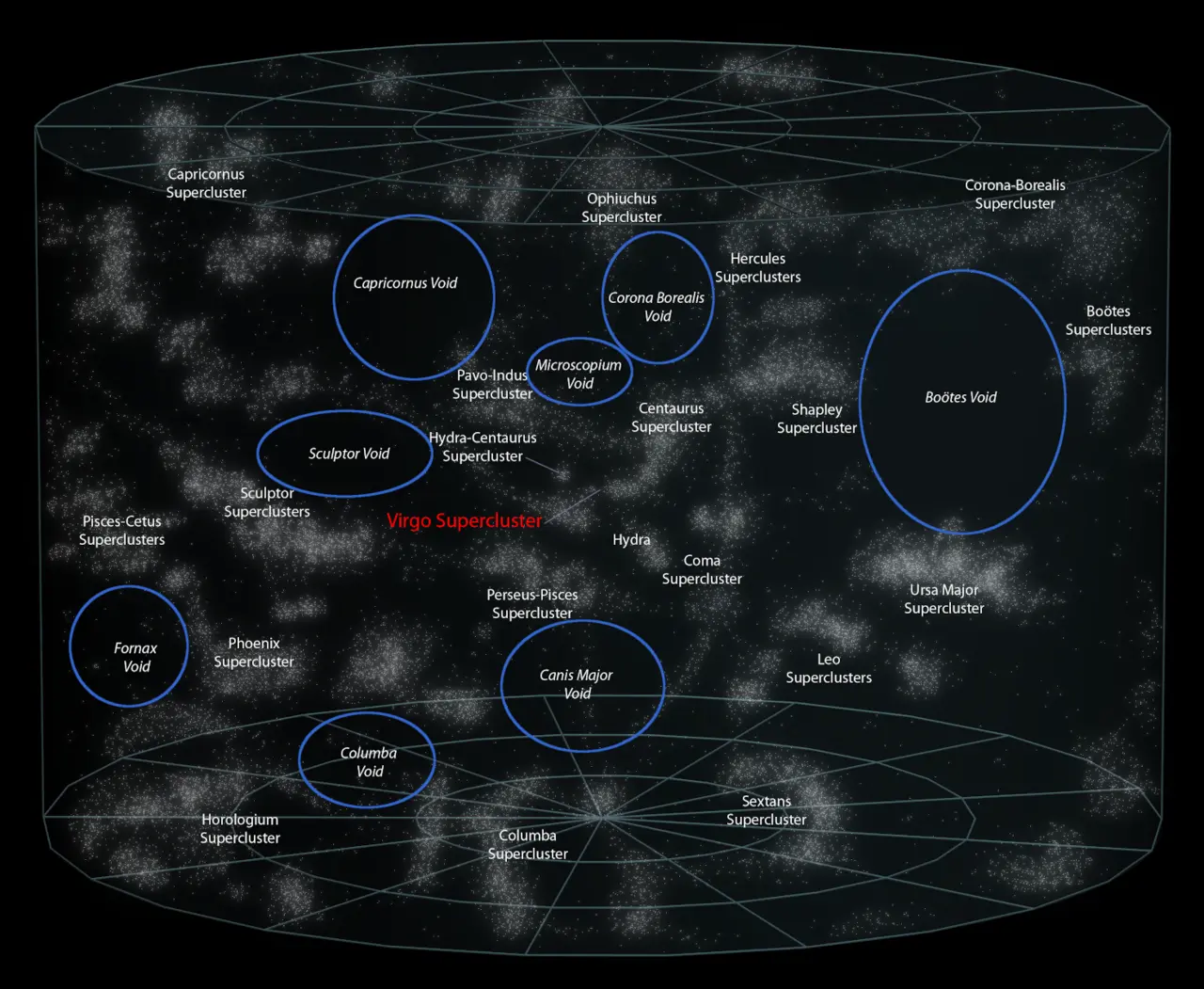
The Boötes Void: The Most Famous Region of "Nothingness"
One of the most famous cosmic voids is the Boötes Void, often referred to as "The Great Nothing".
- Approximately 330 million light-years in diameter.
- Based on average galaxy density, this region should contain several thousand galaxies.
- However, astronomers have only observed about a few dozen galaxies scattered within it.
If one were to stand near the center of this void, the sky would be much darker than what we are accustomed to in the Milky Way, as the nearest galaxies are located very far away.
Is the Cosmic Vacuum Truly "Empty"?
Not entirely.
Even the emptiest regions of the universe still contain:
- A small amount of atoms and subatomic particles.
- Magnetic and electric fields.
- Cosmic rays.
- Cosmic Microwave Background (CMB) radiation.
- Quantum vacuum fluctuations.
In modern physics, a vacuum does not mean "nothingness" but rather a state of extremely low matter density.
The Temperature of Outer Space
Outer space has a background temperature of approximately:
2.725 K (equivalent to −270.4°C)
This temperature originates from the Cosmic Microwave Background (CMB), the leftover light from the early universe approximately 13.8 billion years ago.
Without the CMB, the background temperature of the universe would be even closer to absolute zero (0 K).
Conclusion
🌌 The majority of the universe is a nearly perfect vacuum, where matter density is only a few particles per cubic meter. Despite being very close to absolute emptiness, space still contains radiation, physical fields, and quantum fluctuations. Therefore, according to current physical understanding, "completely empty space" almost does not exist in nature.


