Contents
What is the universe made of?
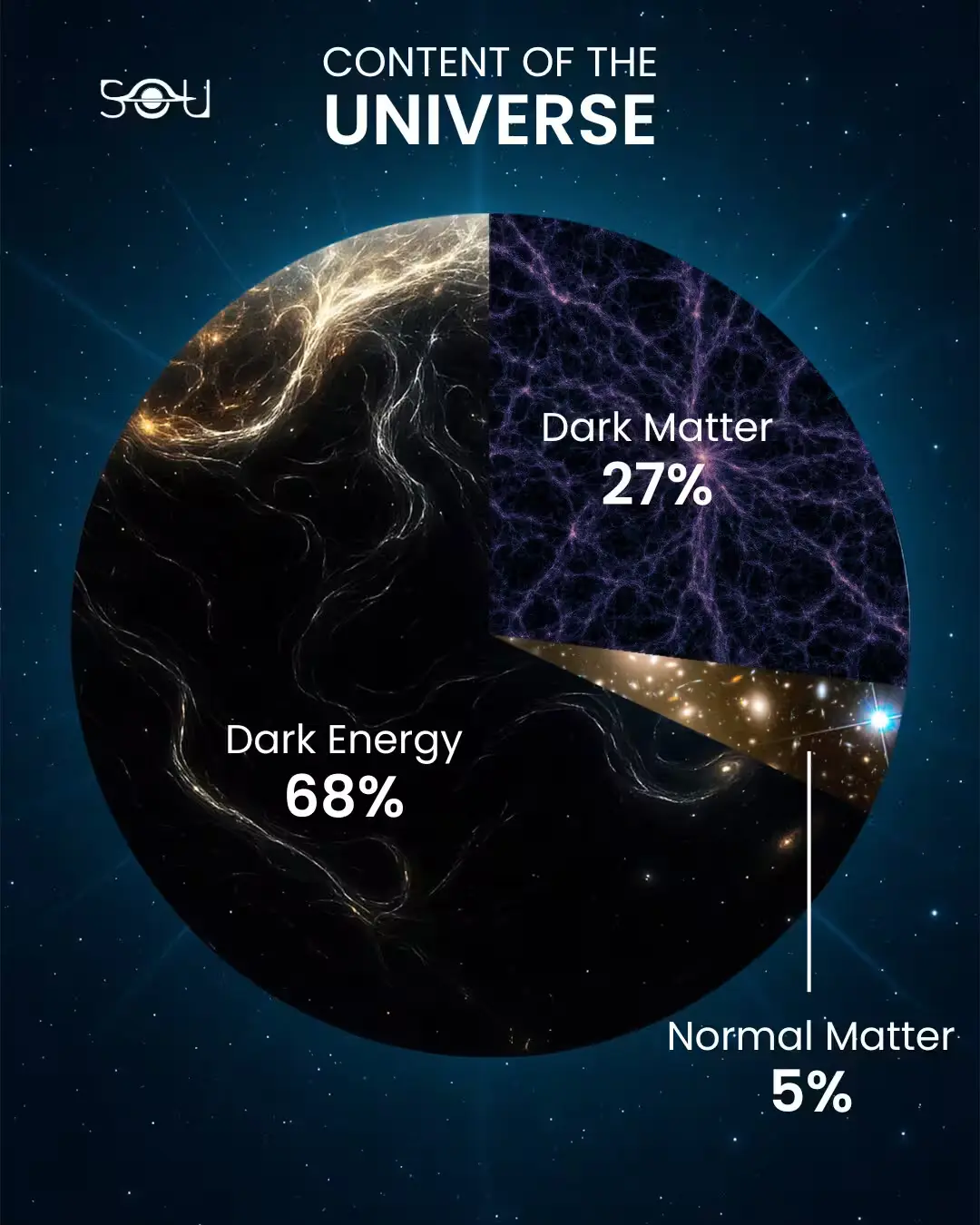
| Component | Proportion |
|---|---|
| Dark energy | ~68% |
| Dark matter | ~27% |
| Ordinary matter | ~5% |
It is astonishing that the part of the universe we actually see is only a tiny fraction of the whole.
How was dark matter discovered?
Galaxy rotation speeds
When measuring the movement of stars at the edges of galaxies, astronomers discovered that they rotate much faster than predicted.
If only visible matter existed, stars at the outer edges should have been rotating much slower.
This suggests that galaxies are surrounded by a large amount of invisible matter, known as dark matter.
Gravitational lensing
According to the theory of general relativity, mass can bend light.
When measuring the distortion of light from distant galaxies, scientists found that the actual total mass is much greater than the observable luminous matter.
What is dark matter?
Currently:
We know that dark matter exists, but we do not yet know what it is.
Many hypotheses have been proposed:
- WIMPs (Weakly Interacting Massive Particles).
- Axions.
- Sterile neutrinos.
- Primordial black holes.
However, no candidate has been confirmed yet.
How was dark energy discovered?
In 1998, astronomers observed very distant Type Ia supernovae to measure the expansion rate of the universe.
They expected to see the expansion of the universe slowing down due to gravity.
The results were exactly the opposite:
The universe is expanding at an ever-increasing rate.
To explain this phenomenon, scientists introduced the concept of dark energy.
What is special about dark energy?
Unlike dark matter, which concentrates around galaxies, dark energy:
- Is distributed almost uniformly throughout space.
- Does not clump into matter.
- Acts as a repulsive effect that accelerates the expansion of the universe.
Because empty space makes up the majority of the universe, even though its density is very low, dark energy has become the dominant component.
The cosmic tug-of-war
The universe can be envisioned as participating in a giant tug-of-war:
Dark matter
- Increases gravitational force.
- Pulls galaxies and matter together.
- Helps form the large-scale structures of the universe.
Dark energy
- Pushes space to expand.
- Drives galaxies further and further apart.
- Dominates the current universe.
For the first few billion years, gravity prevailed. But as the universe became increasingly sparse, dark energy gradually gained the upper hand, causing the expansion to accelerate.
The greatest mystery of modern physics
Currently, scientists:
✅ Know that dark matter exists due to its gravitational effects.
✅ Know that dark energy exists due to its influence on cosmic expansion.
❌ But do not yet know the true nature of either.
🌌 The most surprising thing is that all stars, planets, oceans, living organisms, and humans account for only about 5% of the universe. The rest belongs to two invisible components whose existence modern science has only recently recognized, but does not yet truly understand.
Further reading
References
- [1]Vật chất tối và năng lượng tối — Thiên văn Việt Nam (VACA) — Đặng Vũ Tuấn Sơn (2010)
Image: NASA/CXC/M. Weiss — Wikimedia Commons, Public domain.