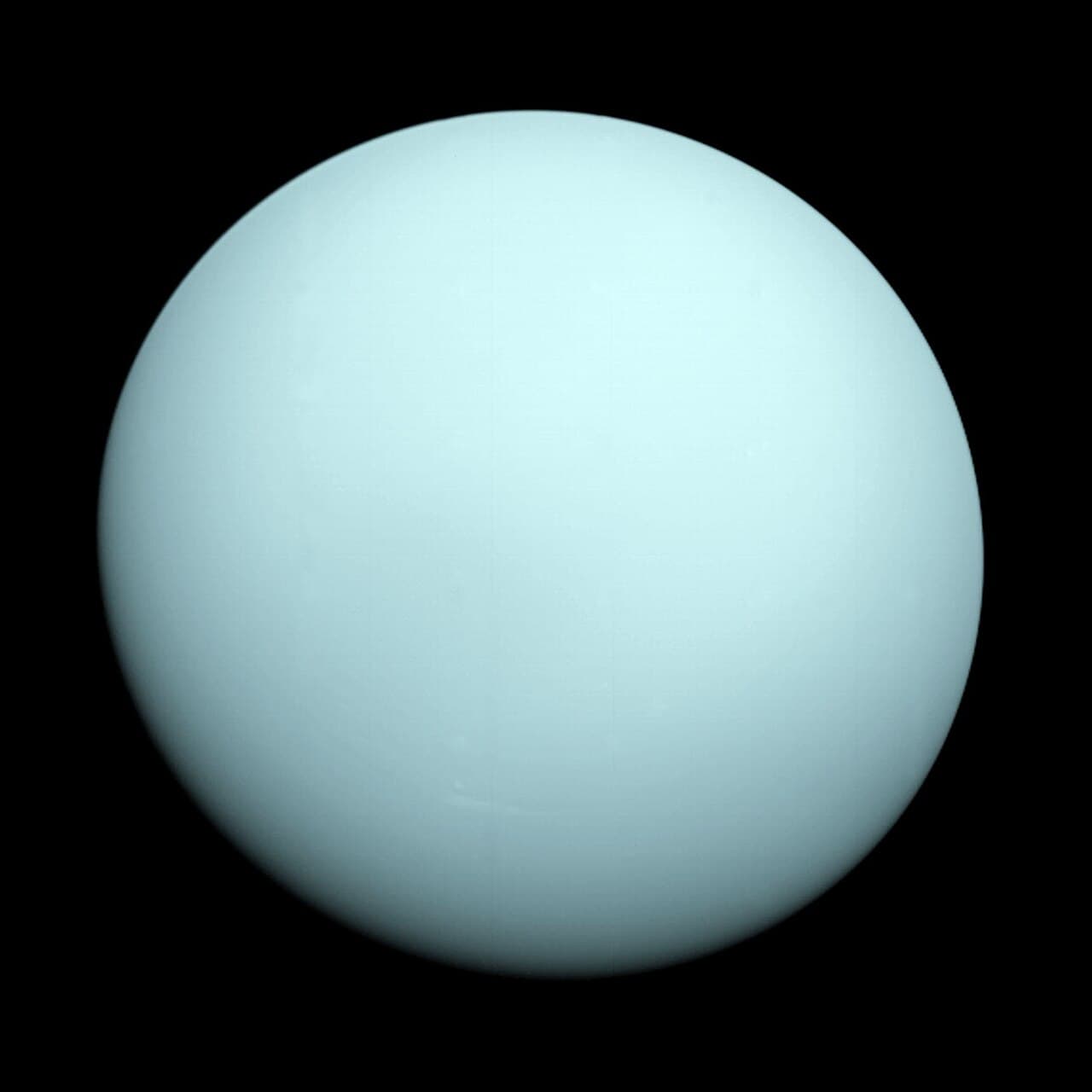
Tilted nearly 98 degrees
Most planets spin like tops, with axes nearly perpendicular to their orbital plane. Uranus, however, is tilted almost completely on its side. The most widely accepted hypothesis is that one or more collisions with planet-sized bodies during its early stages knocked it over.
The result is the most extreme seasons in the Solar System: each pole experiences 42 Earth years of continuous sunlight, followed by 42 years of darkness.
Ice giant
Uranus and Neptune are classified separately as "ice giants." Beneath their hydrogen–helium atmospheres lies a dense mantle of water, methane, and ammonia in a supercritical state — often referred to as "ice" in a chemical sense, rather than conventional frozen water.
Methane in the atmosphere absorbs red light, giving the planet its characteristic pale blue color.
The coldest in the system
Although Neptune is farther from the Sun, Uranus holds the record for the lowest temperature ever measured in a planetary atmosphere: -224°C. The reason may be that this planet radiates almost no additional heat from its interior, unlike the other giant planets.
Only one visit
Voyager 2 flew by in 1986 and remains the only spacecraft to have ever visited. Most of our knowledge about this planet comes from those few hours of observation combined with telescopes.
Read more
References
- [1]Planetary Fact Sheet — NASA NSSDC (2024)
Image: NASA/JPL-Caltech — Wikimedia Commons, Public domain.


