Contents
A planet is a sub-stellar celestial body. Its mass is insufficient to ignite nuclear fusion in its core, meaning a planet does not emit its own light—what we see is merely light reflected from its host star. Most planets orbit a star or a stellar system, though there are planets that wander freely between stars.
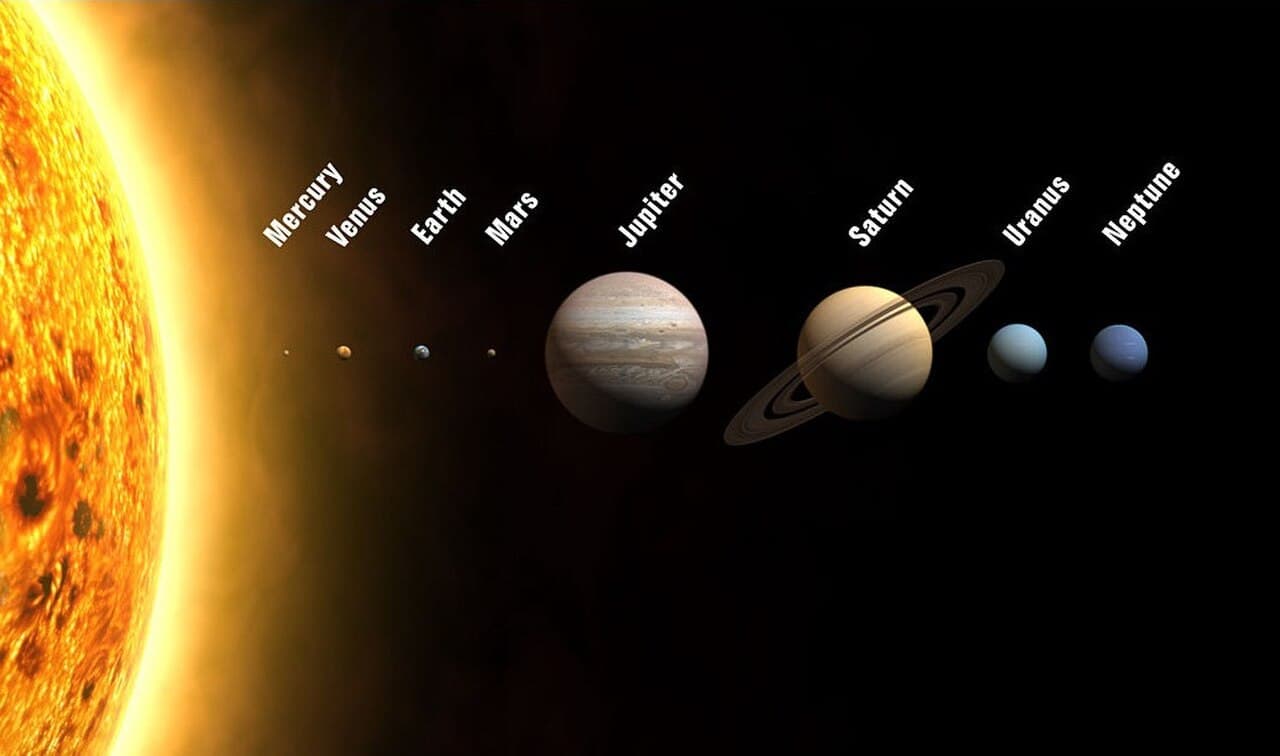
The Solar System has eight planets. This number sounds obvious, but it was only finalized in 2006.
The three conditions of a planet
The problem is that there are many celestial bodies in the Solar System orbiting the Sun. In August 2006, the International Astronomical Union (IAU) issued an official definition, consisting of three conditions that must be satisfied simultaneously:
- It is in orbit around the Sun.
- It has sufficient mass for its self-gravity to overcome rigid body forces, assuming a hydrostatic equilibrium shape—in other words, it must be nearly spherical.
- It has cleared the neighborhood around its orbit, meaning it has cleared other objects from its orbital path, except for its own satellites.
The third condition is the controversial one, and it is the condition that removed Pluto from the list. Pluto is round and orbits the Sun, but it shares its orbital zone with countless other objects in the Kuiper belt.
Pluto was reclassified into a new group: dwarf planets. This group currently has five recognized members—Pluto, Ceres (the largest object in the asteroid belt), Eris, Haumea, and Makemake—along with several candidates awaiting confirmation.
Two very different groups
The eight planets are divided into two distinct groups:
The inner group—Mercury, Venus, Earth, Mars—are terrestrial planets, possessing solid surfaces, small sizes and masses, and few or no satellites.
The outer group—Jupiter, Saturn, Uranus, Neptune—are gas giants, lacking solid surfaces to stand on, and each planet is accompanied by an entire system of satellites. Uranus and Neptune are separated into a smaller branch called ice giants, because beneath their gaseous layers lies a mixture of water, methane, and ammonia at extreme pressures, rather than the metallic hydrogen found in the other two.
The boundary between the two groups is the asteroid belt, and that is no coincidence: in the protoplanetary disk, only at distances sufficiently far from the Sun could water and other volatiles freeze, allowing planetary cores to accumulate quickly and massively enough to retain gas.
Data table
| Planet | Distance (AU) | Orbital Period | Rotation Period | Diameter (km) | Satellites |
|---|---|---|---|---|---|
| Mercury | 0.39 | 88 days | 58.6 days | 4,879 | 0 |
| Venus | 0.72 | 224.7 days | 243 days (retrograde) | 12,104 | 0 |
| Earth | 1.00 | 365.26 days | 23 hours 56 minutes | 12,756 | 1 |
| Mars | 1.52 | 687 days | 24.6 hours | 6,792 | 2 |
| Jupiter | 5.20 | 11.86 years | 9.9 hours | 142,984 | 95 |
| Saturn | 9.54 | 29.4 years | 10.7 hours | 120,536 | 146 |
| Uranus | 19.2 | 84.0 years | 17.2 hours (retrograde) | 51,118 | 28 |
| Neptune | 30.1 | 164.8 years | 16.1 hours | 49,528 | 16 |
One AU (astronomical unit) is the average distance from the Earth to the Sun, approximately 149.6 million km. The number of satellites for the four outer planets changes with each new discovery; the numbers in the table are those officially named as of 2024.
Two things are notable in the table. Venus takes 243 days to complete one rotation, longer than the 225 days it takes to complete an orbit—but that is the sidereal rotation period, not the length of a day. Because Venus rotates in reverse, the solar day there is only about 117 days, which is shorter than a year. Both Venus and Uranus rotate in the opposite direction to the rest.
Where the names come from
The international names of the planets are derived from Roman mythology, and each name is tied to an observable characteristic:
- Mercury is the messenger god who flies as fast as the wind—Mercury has the shortest orbital period, quickly returning to its position relative to the Sun.
- Venus is the goddess of beauty—Venus is the brightest object in the night sky after the Moon. In Vietnamese, this same planet is called "Morning Star" (Sao Mai) when it rises before dawn in the eastern horizon, and "Evening Star" (Sao Hôm) when it sets after dusk in the western horizon.
- Mars is the god of war—due to the red color of iron oxide on its surface.
- Jupiter is the king of the gods—the largest planet in the system.
- Saturn is the father of Jupiter, and Uranus is the father of Saturn: the mythological order follows the distance from the Sun, consistent with the order in which they were discovered.
- Neptune is the god of the sea—the planet has a sea-blue color.
In Eastern culture, the five planets visible to the naked eye are named after the Five Elements—Water, Metal, Fire, Wood, Earth—based on the colors and properties that the ancients assigned to them.
The ninth planet?
In 2016, two astronomers at Caltech announced indirect evidence of an unknown planet very far away: the orbits of a group of Kuiper belt objects cluster in a way that is difficult to explain without the influence of a large mass. To date, that object has not been directly observed, so it is not yet on the official list.
Note on orthography: in Vietnamese, the names of planets are capitalized for both words—Sao Thuỷ, Sao Kim—to distinguish them from the concept of a "star" (sao) in modern astronomy. A planet is not a star.
Edited from the article Các hành tinh của Mặt Trời by Đặng Vũ Tuấn Sơn, published on the Vietnam Astronomy (VACA) website. Original content copyright belongs to VACA.
Further reading
References
- [1]Venus Facts — NASA Science (2024)
- [2]Các hành tinh của Mặt Trời — Thiên văn Việt Nam (VACA) — Đặng Vũ Tuấn Sơn (2007)
Image: WP — Wikimedia Commons, CC BY-SA 3.0.


