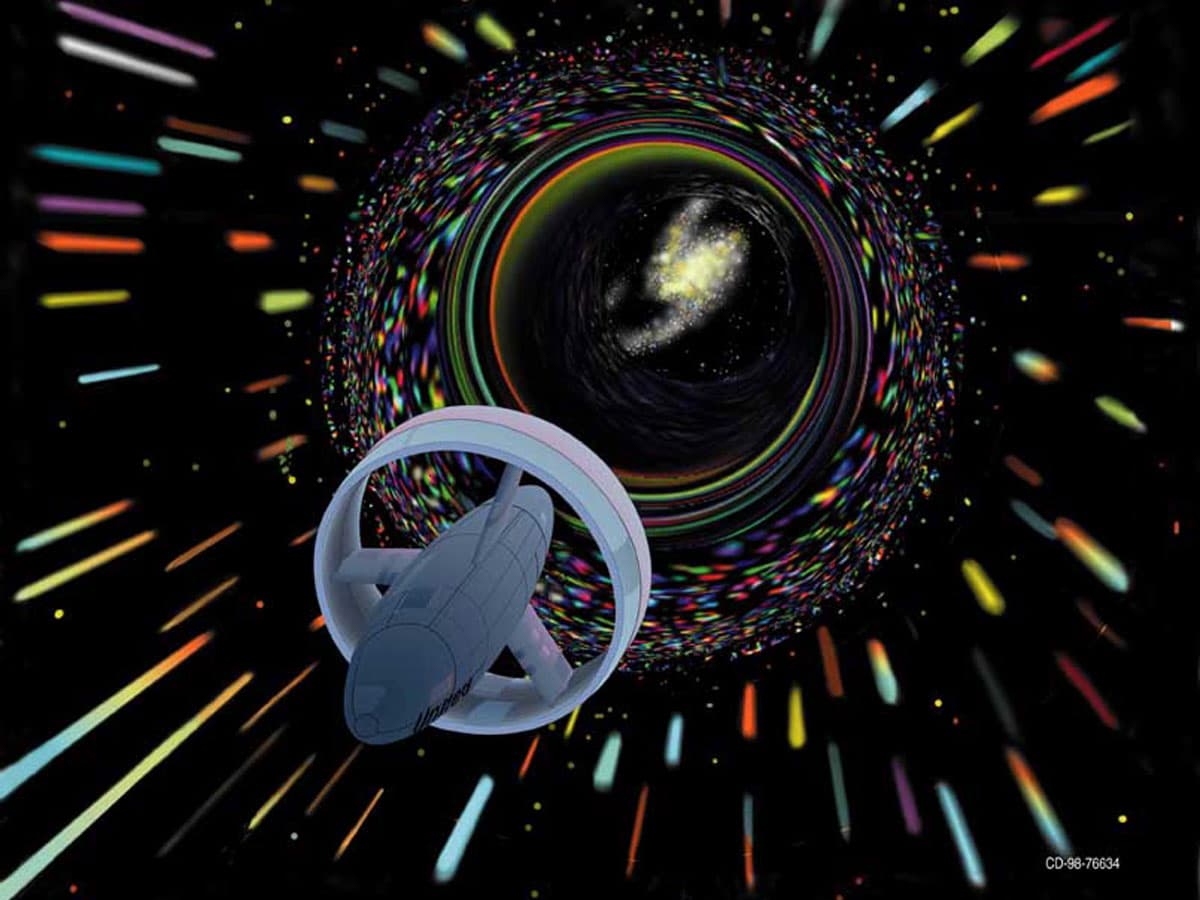
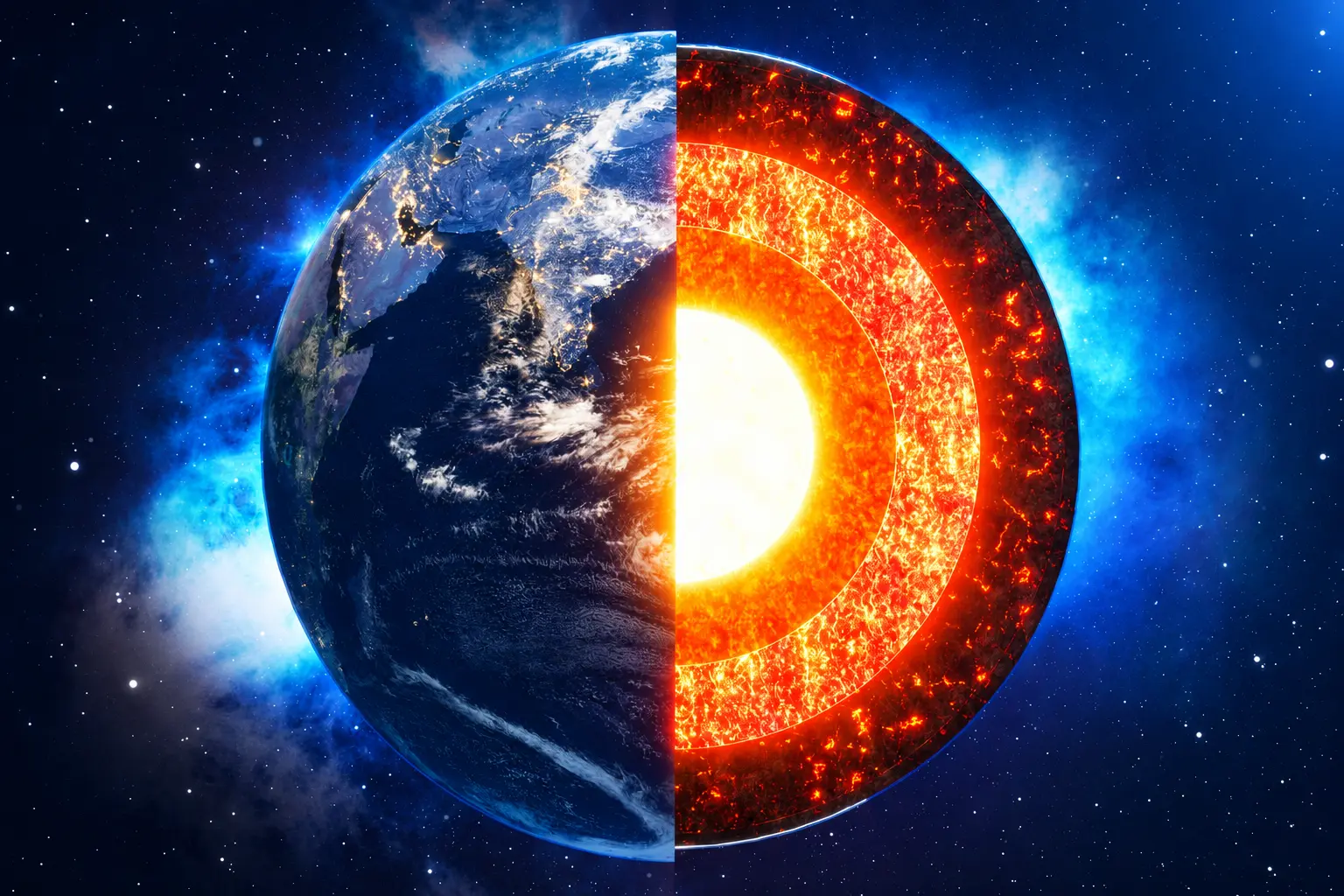
Black holes are often described as cosmic vacuum cleaners. That understanding is wrong. If the Sun were replaced by a black hole of the same mass, Earth's orbit would remain unchanged — it would just get dark.
What makes black holes special isn't their gravitational pull, but their geometry: mass is compressed into a small enough volume that spacetime curvature exceeds a threshold, and from within that boundary, every possible path for light leads inward.
Event horizon
That boundary is called the event horizon. Its radius — the Schwarzschild radius — is directly proportional to its mass:
- A solar-mass black hole: radius ~3 km
- An Earth-mass black hole: radius ~9 mm
- Sagittarius A* at the center of the Milky Way (4.3 million solar masses): ~12.7 million km
The event horizon is not a physical surface. Someone falling through it would not feel anything special at the moment of crossing — but from then on, none of their signals could return.
Three types
Stellar-mass black holes (5–100 solar masses) form when the core of a massive star collapses after a supernova.
Supermassive black holes (millions to billions of solar masses) are located at the center of most large galaxies. The formation mechanism remains an open question.
Intermediate-mass black holes (100–100,000 solar masses) were long merely hypothetical; to date, a few candidates have been confirmed via gravitational waves.
How we "see" them
Black holes themselves do not emit light. We observe them indirectly:
- Motion of surrounding stars. Monitoring the orbits of stars around the center of the Milky Way over decades earned the 2020 Nobel Prize in Physics.
- Accretion disks. Infalling matter is compressed and heated to millions of degrees, emitting brilliant X-rays.
- Gravitational waves. LIGO recorded the merger of two black holes for the first time in 2015 — directly confirming a prediction made by Einstein in 1916.
- Direct imaging. In 2019, the Event Horizon Telescope released the image of the black hole shadow in the M87 galaxy, and in 2022, Sagittarius A*.
Hawking radiation
In 1974, Stephen Hawking showed that quantum effects near the event horizon cause black holes to emit very weak thermal radiation and evaporate extremely slowly. For a stellar-mass black hole, the time for complete evaporation is many orders of magnitude longer than the current age of the universe — so this remains an unobserved theoretical prediction.
Black holes are where general relativity and quantum mechanics are forced to meet, and also where they most clearly conflict.
Further reading
View on the sky map
- Object
- Messier 87
- Catalogue id
- M87
- Coordinates (J2000)
- 12 30 49.42 +12 23 28.0
References
- [1]First Image of a Black Hole — Event Horizon Telescope Collaboration (2019)
- [2]Observation of Gravitational Waves from a Binary Black Hole Merger — Physical Review Letters (2016)
Image: Event Horizon Telescope — Wikimedia Commons, CC BY 4.0.