Freshly added to the library
The nucleus holds almost all of an atom's mass; the electrons hold almost all of its volume. This article works through the three numbers behind that structure — the proton count Z that fixes the element, the mass number A that separates the isotopes, and the mass missing from ¹²C — using CODATA 2022, NIST and IAEA data.
Mass and inertia are two ways of describing one property; weight is a force, measured in newtons, that changes with where you stand. This article sets the three quantities side by side as NIST and BIPM define them, explains why "weightless" does not mean gravity is gone, and why the equality of inertial and gravitational mass remains an open question.
Kepler said how the planets move; Newton said why. This article gives the three laws as NASA renders them from the Principia, the rigorous form of the second law (force as the rate of change of momentum), the point where the third law is most often misread, and the range over which the three laws still hold.
Energy is a scalar quantity measured in joules, and in a closed system that number does not change. This article covers the working definition and where it falls short, the SI unit, the main forms of energy, and why the total stays the same through every conversion.
No single method stands alone: parallax calibrates Cepheids, Cepheids calibrate Type Ia supernovae, and those calibrate the Hubble constant — which is why a disagreement at the top forces a re-check of every rung below.
Barely heated or altered in 4.6 billion years, comets are the closest thing we have to the raw material the planets were built from — and Rosetta's in-situ data revised a good deal of what was believed about them.
A gravitational wave is a ripple in spacetime that needs no medium; a gravity wave is a mechanical oscillation of water or air that cannot exist without one. The two are routinely confused in translation.
A solar eclipse is the Moon's shadow sweeping across Earth; a lunar eclipse is the Moon entering Earth's shadow. That difference sets how wide the viewing zone is, how long it lasts, and whether eye protection is required.
What arrives from the Sun is energy; the light itself comes from oxygen atoms and nitrogen molecules high in the atmosphere after electrons strike them — and the lifetime of each excited state is why each altitude has its own colour.
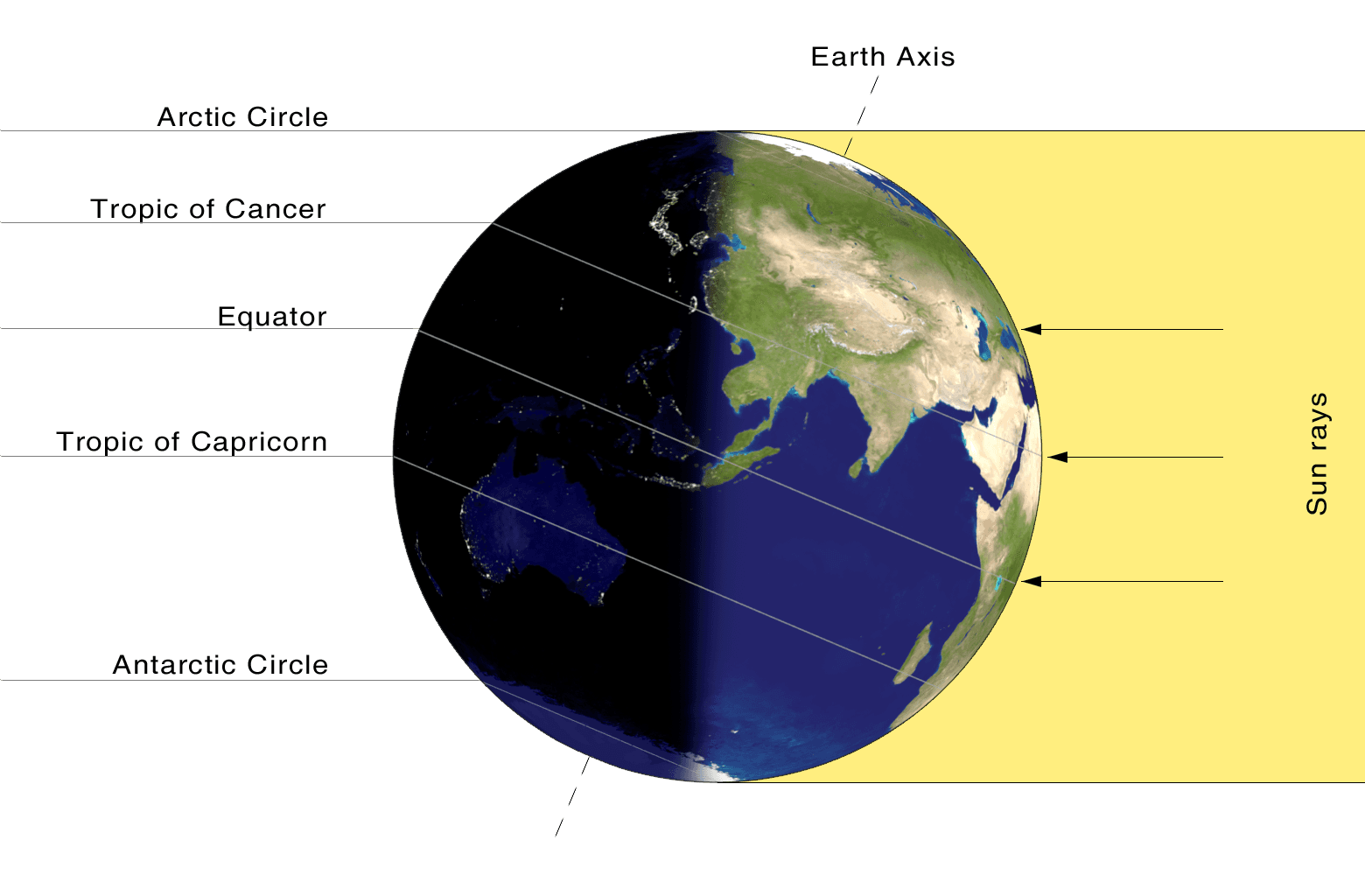
Earth is closest to the Sun in early January — the middle of the northern winter. Seasons come not from how much energy arrives but from how the 23.44° axial tilt distributes it between hemispheres and across the year.
It all began with a collapsing cloud of gas and dust 4.57 billion years ago. The hardest question is not how planets formed, but why the Sun holds 99.86% of the mass yet only 1% of the angular momentum.
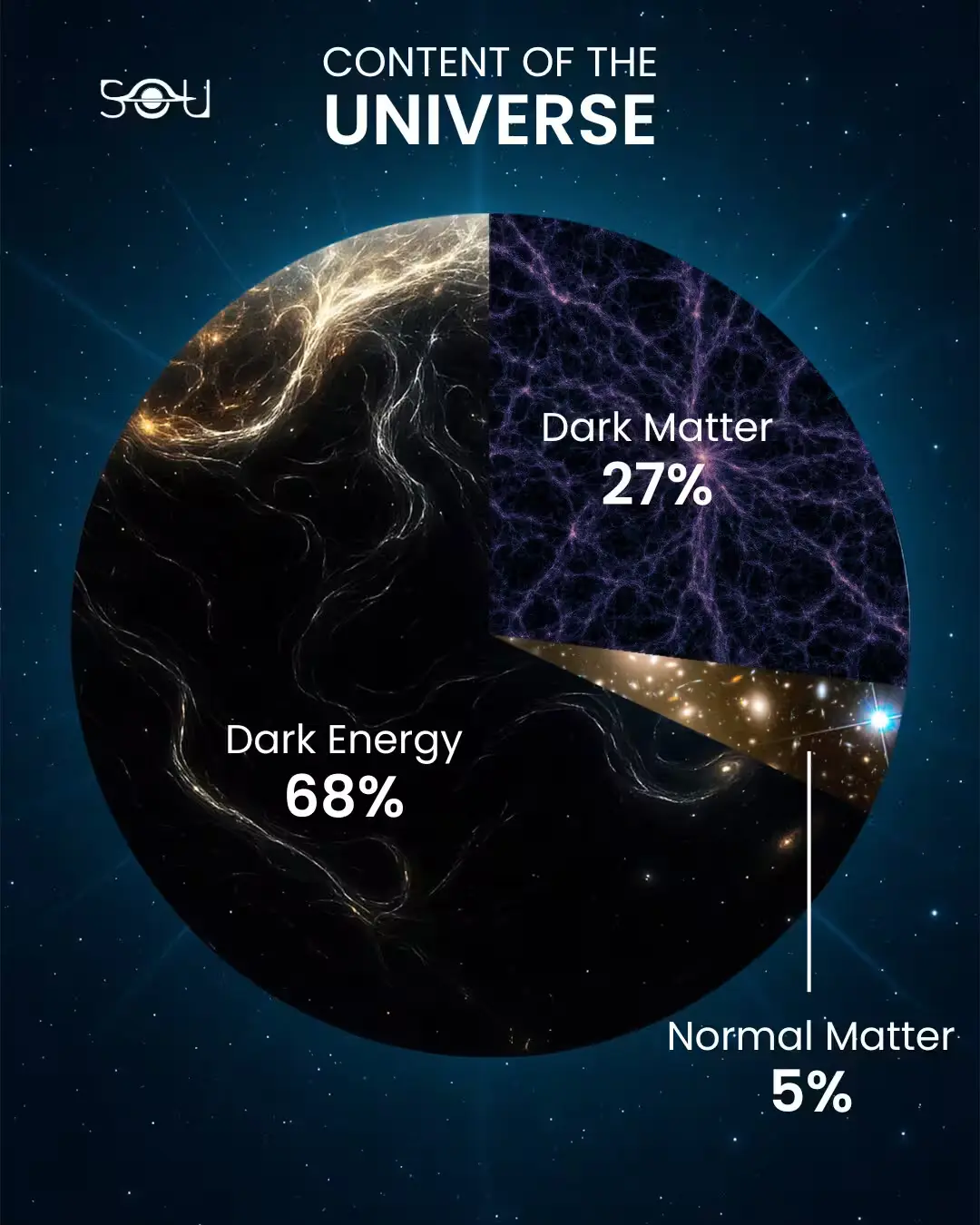
They share only the word "dark" and the fact that nobody has seen either. One pulls matter together, the other pushes space apart. Together they are 95% of the universe, and we do not know what either one is.