Contents
When is Earth Closest to the Sun?
Earth's orbit is elliptical, so the distance to the Sun changes throughout the year.
- Closest in early January.
- Farthest in early July.
Interestingly, the Northern Hemisphere is in the middle of winter when Earth is closest to the Sun.
Therefore, distance is not the cause of the seasons.
The Real Cause: Earth’s Axial Tilt
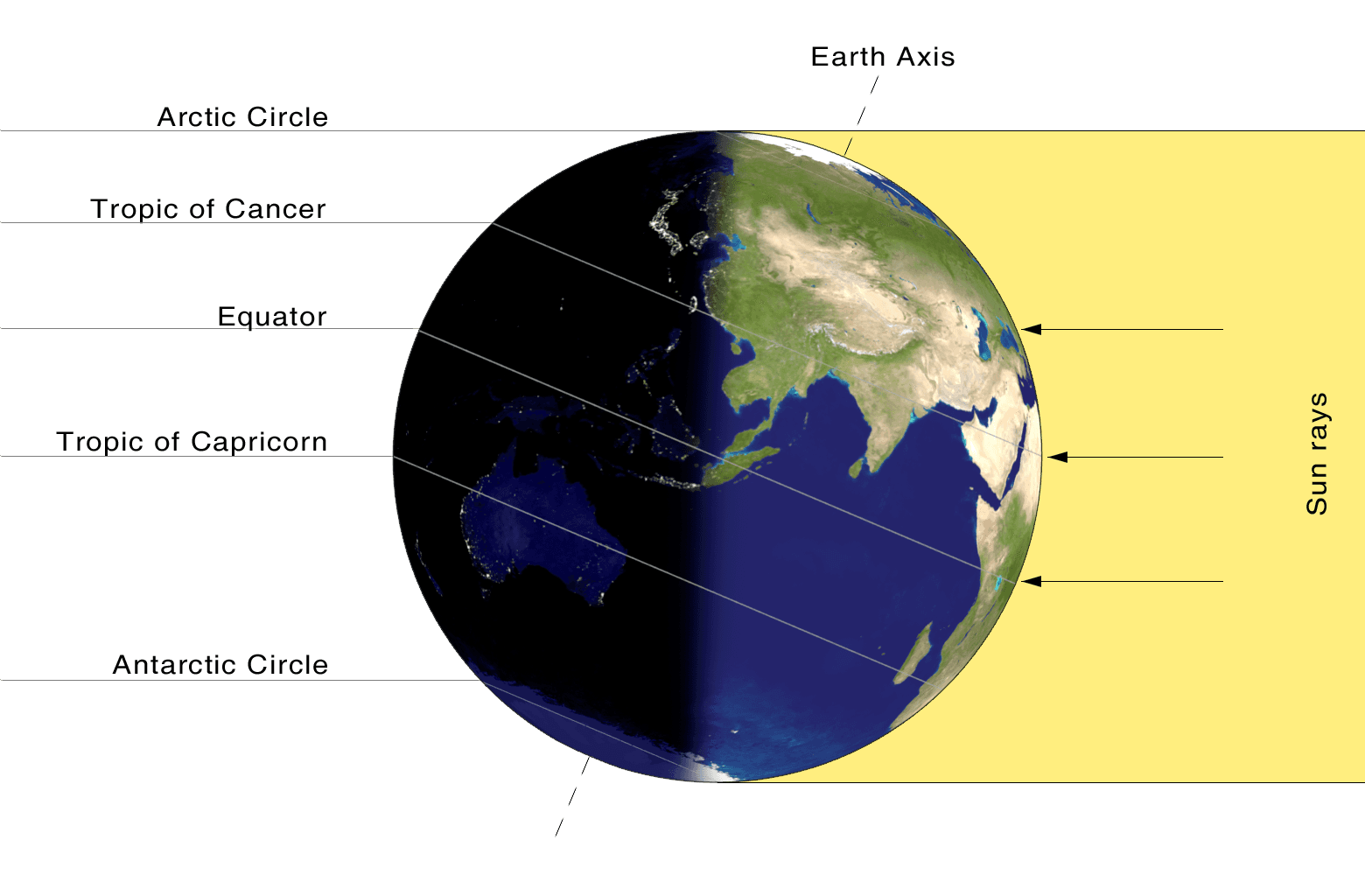
Earth’s axis of rotation is tilted approximately 23.44° relative to the orbital plane.
Throughout the year, this tilt direction remains nearly constant. As Earth moves around the Sun:
- At times, the Northern Hemisphere tilts more toward the Sun.
- At times, the Southern Hemisphere tilts more toward the Sun.
The hemisphere tilted toward the Sun receives more energy and enters summer.
Why Does the Tilt Change the Temperature?
There are two main reasons:
The Angle of Sunlight
When light shines nearly perpendicularly onto the ground, energy is concentrated over a smaller area, causing the ground to heat up faster.
Conversely, oblique sunlight spreads over a larger area and heats the surface less efficiently.
Day Length
In summer:
- The days are longer.
- The ground receives sunlight for a longer duration.
In winter:
- The days are shorter.
- There is less time to receive heat from the Sun.
Why Isn't the Hottest Day the Summer Solstice?
The summer solstice is the time when the Northern Hemisphere receives the most solar energy in the year.
However, landmasses and oceans need time to absorb and store heat, so the highest temperatures usually occur about several weeks to two months later.
This phenomenon is known as seasonal lag.
Does Vietnam Have Four Seasons Like Temperate Countries?
Most of Vietnam is located in the tropics, so the change in temperature between seasons is not very large.
Instead, seasons are often distinguished by:
- The rainy season.
- The dry season.
Northern Vietnam, specifically, still experiences a distinct winter due to the influence of cold air masses from the Asian continent.
Do Other Planets Have Seasons?
Seasons depend primarily on axial tilt.
- Venus has almost no seasons because its axis is only slightly tilted.
- Mars has seasons relatively similar to Earth's.
- Uranus is tilted at nearly 98°, meaning each pole can experience over 40 years of continuous sunlight followed by 40 years of darkness.
🌍 The distance to the Sun determines the total amount of energy Earth receives, but it is the axial tilt that determines how that energy is distributed between the hemispheres and across different times of the year. In other words, seasons are a story of how energy is divided, not of distance.
Read more
References
- [1]Long-Term Variations of Daily Insolation and Quaternary Climatic Changes — Journal of the Atmospheric Sciences 35, 2362 (1978)
- [2]Variations in the Earth's Orbit: Pacemaker of the Ice Ages — Science 194, 1121 (1976)
- [3]Astronomical Information Center — ngày phân và độ dài ngày đêm — United States Naval Observatory (2024)
- [4]Earth Fact Sheet — độ nghiêng trục, độ lệch tâm, khoảng cách cận nhật và viễn nhật — NASA Goddard Space Flight Center (2024)
- [5]Planetary Fact Sheets — độ nghiêng trục và chu kỳ quỹ đạo của Sao Kim, Sao Hoả và Sao Thiên Vương — NASA Goddard Space Flight Center (2024)
- [6]Nguyên nhân của mùa trên Trái Đất — Thiên văn Việt Nam (VACA) — Lưu Xuân Bình (2013)
- [7]Astronomical Algorithms, ấn bản 2 — công thức độ cao Mặt Trời lúc giữa trưa và độ dài các mùa; bản tính trực tuyến tương đương của NOAA — Willmann-Bell / NOAA Global Monitoring Laboratory (1998)
Przemysław "Blueshade" Idzkiewicz / Wikimedia Commons — CC BY-SA 4.0


