Contents
A wave is a disturbance travelling through space, carrying energy but not matter. NOAA puts it most compactly for ocean waves: "Waves transmit energy, not water, across the ocean." A buoy bobs in place rather than being carried to the far shore: what moves is the shape of the disturbance, not the medium.
Four quantities, one relation
Wavelength λ is the distance between two successive crests — NASA: "The distance between crests is the wavelength." Frequency f is "the number of crests that pass a given point within one second"; one cycle per second "is called a Hertz (Hz)". Period T is the time for one complete oscillation, so T = 1/f. Amplitude is "the strength, or intensity of the wave", which NASA likens to the loudness of a sound.
Wavelength, frequency and propagation speed are not independent, and that follows directly from the definitions themselves: if f crests pass a point each second and successive crests are λ apart, the disturbance advances λf in one second. Speed equals wavelength times frequency. For light, NASA writes the relation as "wavelength ... is equal to the speed of light (c) divided by frequency (f)". An FM station broadcasting at 100 MHz therefore has a wavelength of roughly 3.0 m; green light at 550 nm corresponds to a frequency of about 5.45 × 10¹⁴ Hz.
The measurement system rests on a frequency
Frequency is not a borrowed quantity. The second — the SI unit of time — is defined by BIPM by fixing the caesium frequency ΔνCs, "the unperturbed ground-state hyperfine transition frequency of the caesium 133 atom", at exactly 9 192 631 770 Hz. The metre is defined by fixing the speed of light in vacuum at exactly 299,792,458 m/s: a metre is "the length of the path traveled by light in a vacuum in 1/299,792,458 of a second" (NIST). Both of the quantities underpinning every measurement are therefore anchored to a property of waves.
Mechanical waves and electromagnetic waves
The biggest dividing line between kinds of waves: does it need a medium?
Sound does. In NASA's Ask Us pages, sound waves "are a result of the compressive disturbance of a continuous medium (air, liquid, solid)", so in a perfect vacuum there is no sound. Its speed is set by the medium, following a = √(γRT) with T the absolute temperature; NASA Glenn gives, for a standard day at sea level static conditions, a speed of sound in air of "about 761 mph" — some 340 m/s. At that speed, concert-pitch A at 440 Hz has a wavelength of about 77 cm.
Light does not. "Light doesn't need a medium that it has to agitate. Light is electric and magnetic fields", also from NASA. Dividing the speed of light in vacuum by the speed of sound just quoted gives roughly 880,000; and c is not merely the speed of light but a constant built into the structure of spacetime. Visible light — including the light an atom emits when an electron drops to a lower energy level — spans only about 380 to 700 nm, the range NASA says the human eye typically detects, a very thin slice of the electromagnetic spectrum. Gravitational waves also need no medium, but what oscillates there is spacetime itself rather than an electromagnetic field.
Transverse and longitudinal: the Earth shows its hand
A longitudinal wave oscillates along the direction of travel; a transverse wave oscillates perpendicular to it. Seismology gives the cleanest example: one earthquake emits both at once. USGS describes P waves as alternately compressing and stretching "the crustal material parallel to the direction they are propagating", while S waves "cause the crustal material to move back and forth perpendicular to the direction they are travelling". The P waves arrive first.
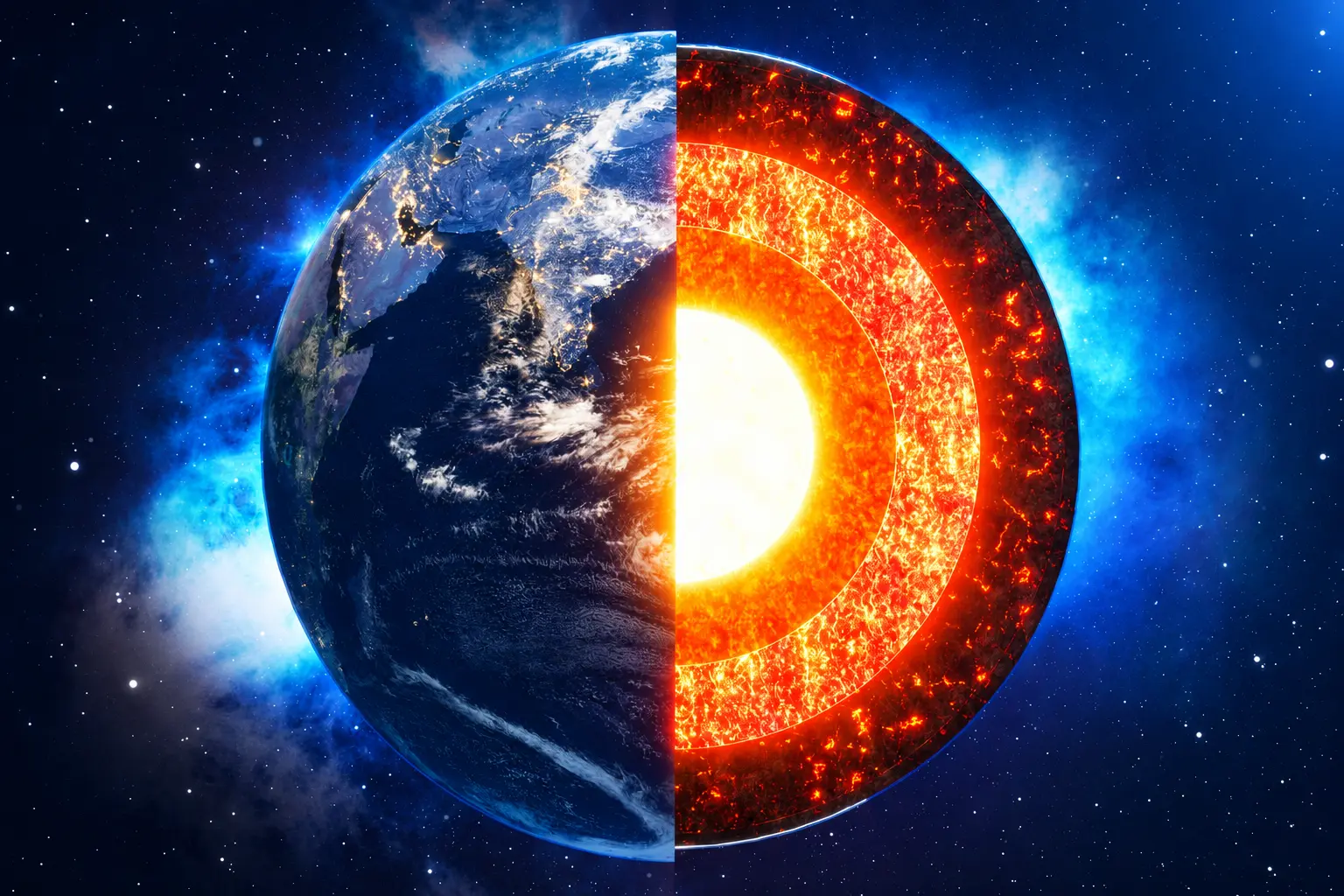
"S waves do not travel through liquid." After a large earthquake there is a band on the Earth's surface — USGS puts it at "angular distances of 104 to 140 degrees" — that receives no direct P waves; that shadow zone forms from "S waves ... being stopped entirely by the liquid core and P waves being bent (refracted) by the liquid core". Observations of seismic waves like these are how the Earth's outer core was found to be liquid. Light, too, is a transverse wave.
Amplitude says nothing about frequency
The two are independent: a frequency can be entirely familiar while the amplitude is almost too small to measure. Of GW150914, the first gravitational-wave signal detected directly, the discovery paper reports that "the signal sweeps upwards in frequency from 35 to 250 Hz with a peak gravitational-wave strain of 1.0 × 10⁻²¹" (Abbott et al., PRL, 2016). That frequency figure sits well inside the range human ears detect, roughly 20 Hz to 20 kHz — though what oscillates here is spacetime rather than air, so nobody hears anything. The amplitude is the hard part: small enough that it took a century to build an instrument that could reach it.
What waves do at an obstacle
NASA defines the basic behaviours very briefly: refraction is "when light waves change direction as they pass from one medium to another"; diffraction is "the bending and spreading of waves around an obstacle".
Refraction is where wavelength shows itself most clearly: "different wavelengths of light are slowed at different rates, which causes them to bend at different angles". That is the mechanism behind a rainbow, and behind a prism splitting white light into a band of colour.
References
- [1]Observation of Gravitational Waves from a Binary Black Hole Merger — B. P. Abbott và cs. (LIGO/Virgo), Physical Review Letters 116, 061102 (2016)
- [2]Waves — Ocean Facts: sóng truyền năng lượng, không truyền nước — NOAA National Ocean Service
- [3]Speed of Sound (Beginner's Guide to Aeronautics) — NASA Glenn Research Center
- [4]The Science of Earthquakes — sóng P và sóng S — U.S. Geological Survey, Earthquake Hazards Program
- [5]Seismic Shadow Zone — vùng không nhận được sóng P trực tiếp — U.S. Geological Survey, Earthquake Hazards Program
- [6]P-wave and S-wave paths through the earth — U.S. Geological Survey
- [7]Wave Behaviors — reflection, refraction, diffraction, absorption — NASA Science Mission Directorate
- [8]Visible Light — dải bước sóng mắt người phát hiện được — NASA Science Mission Directorate
- [9]Basics of Space Flight — Chapter 6: Electromagnetics — NASA Jet Propulsion Laboratory / NASA Science
- [10]Anatomy of an Electromagnetic Wave — NASA Science Mission Directorate (2023)
- [11]SI Redefinition — The Meter — National Institute of Standards and Technology (2019)
- [12]SI base unit: metre (m) — định nghĩa qua tốc độ ánh sáng c — Bureau International des Poids et Mesures (SI Brochure, 9th ed.) (2019)
- [13]SI base unit: second (s) — định nghĩa qua tần số caesium ΔνCs — Bureau International des Poids et Mesures (SI Brochure, 9th ed.) (2019)
- [14]Cosmicopia — Ask Us: General Physics, Waves, Light and Sound — NASA Goddard Space Flight Center (2004)
- [15]The Audible Spectrum — trong Neuroscience, 2nd edition — Purves D. và cs. (biên tập), Sinauer Associates — qua NCBI Bookshelf (2001)
Image: Pawel Czerwinski - Unsplash