25 articles
The sensation of being pulled backward during acceleration or thrown forward during sudden braking is not caused by a mysterious force, but is the result of inertia—an inherent property of all objects with mass.
Each morning, the Sun does not actually "rise" from the horizon. Instead, Earth’s rotation carries our location into the sunlit region. At the equator, the planet’s surface moves at approximately 1,670 km/h, faster than most commercial aircraft. Why, then, do we not perceive this motion, and why are we not flung into space?
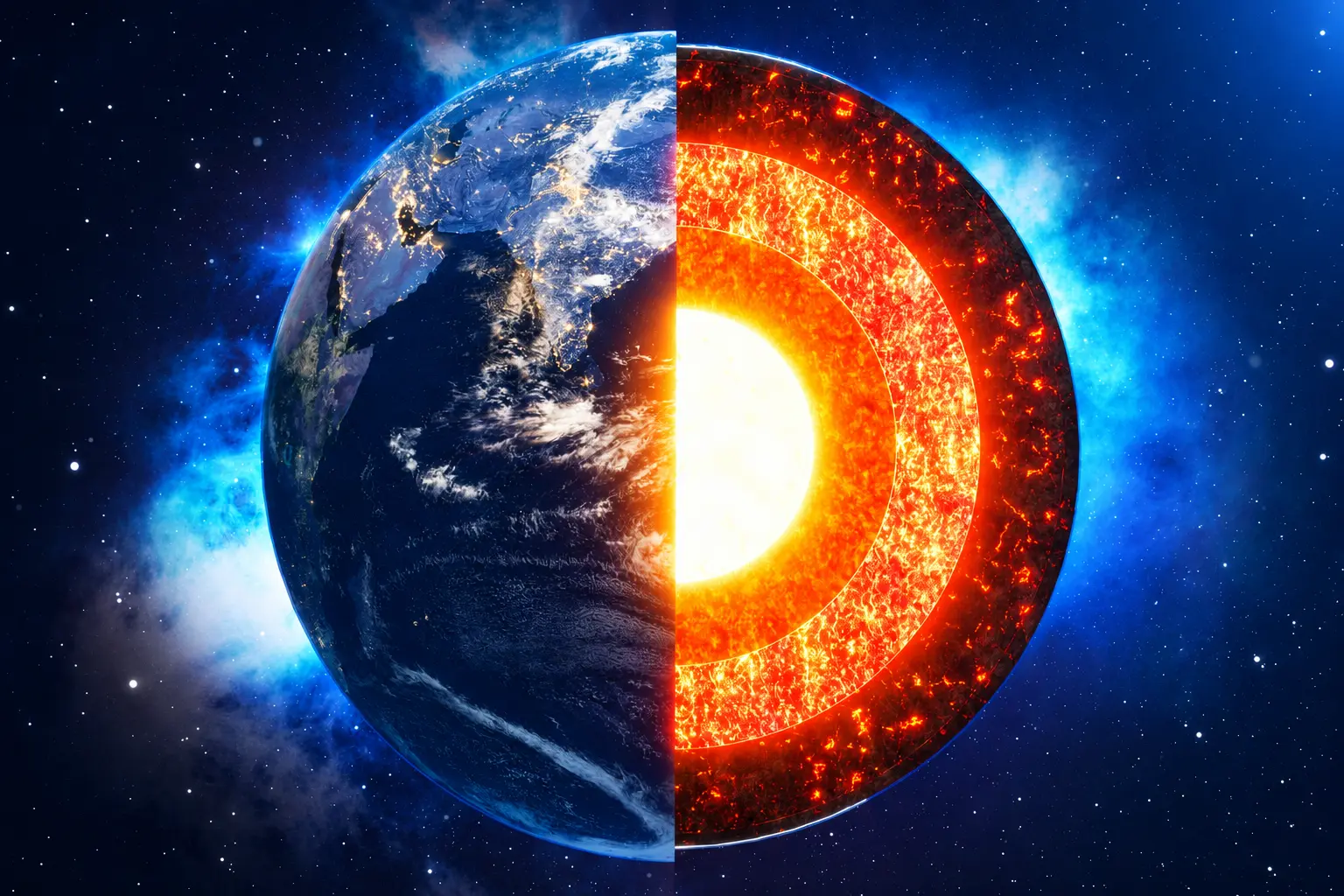
By chemical composition Earth has three layers — crust, mantle and core — but the core splits into a liquid outer core and a solid inner core. Only the crust is within reach: the Kola borehole reached 12 km and never crossed the crust–mantle boundary. The rest is reconstructed from seismic waves and from rock compressed at high pressure, following USGS, NASA, IRIS and Anzellini and colleagues (2013).
An electric current is charge in motion. This article defines the elementary charge and the coulomb, retraces how the ampere moved from a force between two wires to a fixed constant, and separates conventional current direction from the direction electrons actually travel, following BIPM, NIST, NWS and NASA.
A wave carries energy, not matter. This article defines the four quantities behind every periodic wave — wavelength, frequency, period and amplitude — then uses them to separate mechanical waves from electromagnetic ones, and transverse waves from longitudinal ones, following BIPM, NASA and USGS.
The nucleus holds almost all of an atom's mass; the electrons hold almost all of its volume. This article works through the three numbers behind that structure — the proton count Z that fixes the element, the mass number A that separates the isotopes, and the mass missing from ¹²C — using CODATA 2022, NIST and IAEA data.
Mass and inertia are two ways of describing one property; weight is a force, measured in newtons, that changes with where you stand. This article sets the three quantities side by side as NIST and BIPM define them, explains why "weightless" does not mean gravity is gone, and why the equality of inertial and gravitational mass remains an open question.
Kepler said how the planets move; Newton said why. This article gives the three laws as NASA renders them from the Principia, the rigorous form of the second law (force as the rate of change of momentum), the point where the third law is most often misread, and the range over which the three laws still hold.
Energy is a scalar quantity measured in joules, and in a closed system that number does not change. This article covers the working definition and where it falls short, the SI unit, the main forms of energy, and why the total stays the same through every conversion.
A gravitational wave is a ripple in spacetime that needs no medium; a gravity wave is a mechanical oscillation of water or air that cannot exist without one. The two are routinely confused in translation.
It all began with a collapsing cloud of gas and dust 4.57 billion years ago. The hardest question is not how planets formed, but why the Sun holds 99.86% of the mass yet only 1% of the angular momentum.
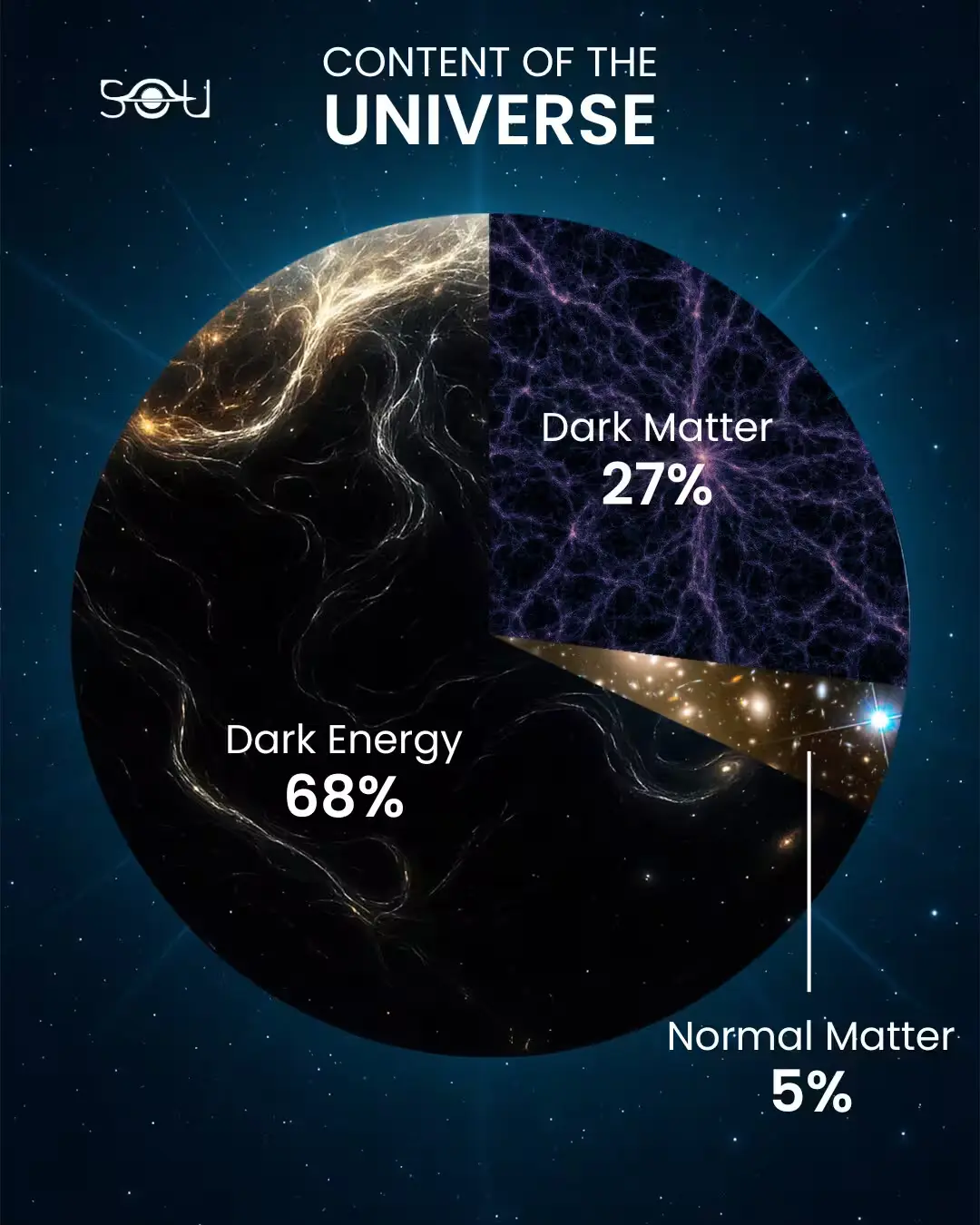
They share only the word "dark" and the fact that nobody has seen either. One pulls matter together, the other pushes space apart. Together they are 95% of the universe, and we do not know what either one is.