Contents
- The observable universe is not the entire universe
- Four levels of the multiverse
- Level 1: Beyond the observational horizon
- Level 2: Bubble universes
- Level 3: Quantum many-worlds
- Level 4: Every mathematical structure exists
- Is there any evidence?
- Is the multiverse science?
- Arguments against
- Arguments in favor
- Conclusion
- Further reading
The observable universe is not the entire universe
The observable universe is the region from which light has had time to reach us since the Big Bang, with a radius of about 46.5 billion light-years.
This boundary is not a physical wall, but merely an observational limit. Beyond it, there may still be vast amounts of space that we cannot see.
Therefore, when asking "what is outside the universe?", one must first realize that no one has yet determined whether the entire universe is finite or infinite.
Four levels of the multiverse
Cosmologist Max Tegmark proposed four distinct levels of the multiverse.
Level 1: Beyond the observational horizon
If space is infinite, then beyond the region we can observe, other regions of the same universe still exist.
The laws of physics are identical, differing only in the arrangement of matter.
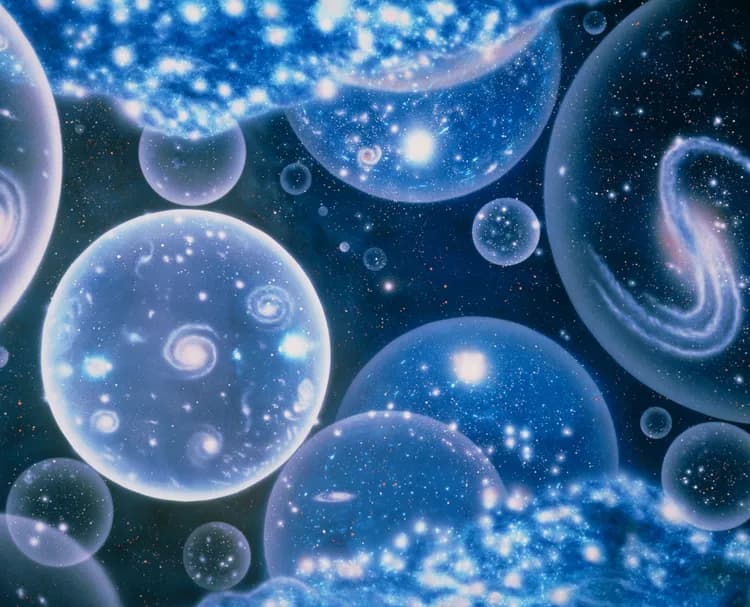
Level 2: Bubble universes
In some cosmic inflation models, space can form countless separate "bubbles".
Each bubble is a distinct universe and may possess different physical constants.
Level 3: Quantum many-worlds
According to the many-worlds interpretation of quantum mechanics, every possible outcome actually occurs, but in different branches of reality.
Every quantum choice creates a new branch of the universe.
Level 4: Every mathematical structure exists
This is the most daring level.
Not only are physical constants different, but universes with entirely different laws of physics also exist if they correspond to a consistent mathematical structure.
Is there any evidence?
Currently:
There is no widely accepted observational evidence for the existence of the multiverse.
There have been some efforts to find traces of collisions between "bubble universes" in the cosmic microwave background radiation, but so far the results remain unconvincing.
Is the multiverse science?
This remains a subject of debate.
Arguments against
A hypothesis that cannot be tested or falsified through observation falls outside the realm of empirical science.
Arguments in favor
If the multiverse is an inevitable consequence of tested theories, such as certain models of cosmic inflation, then it is still worth studying as part of science.
Conclusion
The multiverse currently lies at the intersection of physics, philosophy, and theoretical cosmology. It is not a confirmed idea, nor is it merely science fiction.
🌌 What is most certain right now is that we have observed only a tiny fraction of the universe. Whether other universes exist remains one of the greatest questions in modern science.
Further reading
References
- [1]Đa vũ trụ, giới hạn của không gian? — Thiên văn Việt Nam (VACA) — Đặng Vũ Tuấn Sơn (2011)
Image: NASA / WMAP Science Team — Wikimedia Commons, Public domain.