Paper discovery
In the early 19th century, astronomers noticed that Uranus's orbit deviated from predictions. Urbain Le Verrier and John Couch Adams independently calculated the position of an unknown planet causing the perturbation. In 1846, Johann Galle pointed his telescope toward the coordinates provided by Le Verrier and found Neptune within an hour, less than 1 degree off.
This remains one of the finest demonstrations of the predictive power of celestial mechanics.
2,100 km/h winds
Neptune receives only 1/900th the sunlight that Earth does, yet its atmosphere is the most active in the solar system. Winds reach approximately 2,100 km/h — far exceeding the speed of sound in Earth's atmosphere.
The energy source for this activity comes from internal heat: Neptune radiates about 2.6 times the energy it receives from the Sun.
The Great Dark Spot
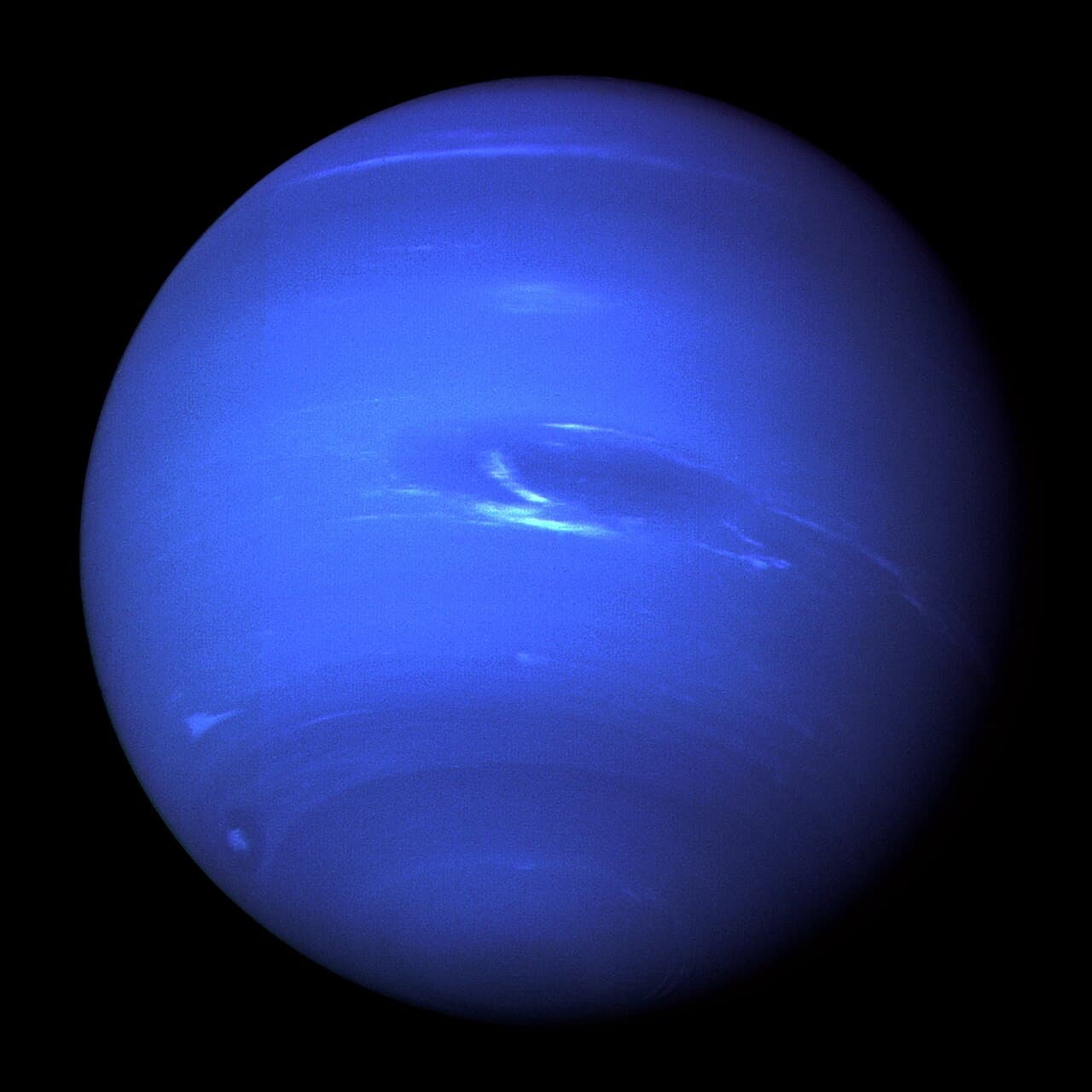
Voyager 2 captured a dark storm vortex roughly the size of Earth in 1989. When Hubble observed it again a few years later, it had vanished — and new dark spots had appeared elsewhere. Unlike Jupiter's persistent Great Red Spot, storm structures on Neptune only last for a few years.
Triton
Neptune's largest moon orbits in the opposite direction of the planet's rotation — a clear sign that it is a captured Kuiper Belt object. Triton exhibits nitrogen geyser activity and is slowly spiraling inward; in a few billion years, it will be torn apart by tidal forces into a new ring system.
Further reading
References
- [1]Planetary Fact Sheet — NASA NSSDC (2024)
Image: NASA — Wikimedia Commons, Public domain.


