Contents
How deep have we drilled?
A Soviet borehole on the Kola Peninsula reached 12 km and still has not pierced the crust–mantle boundary.
That sounds like a lot, but against the roughly 6,375 km from the surface to the centre (half the 12,750 km diameter USGS gives), 12 km is only 0.19%.
How do we know what is inside the Earth?
When an earthquake happens, seismic waves travel through the planet.
- P waves travel through both solids and fluids.
- S waves travel only through solids.
S waves do not appear beyond an angular distance of about 103° from the epicentre (IRIS) — that is the main reason the outer core is presumed to be liquid.
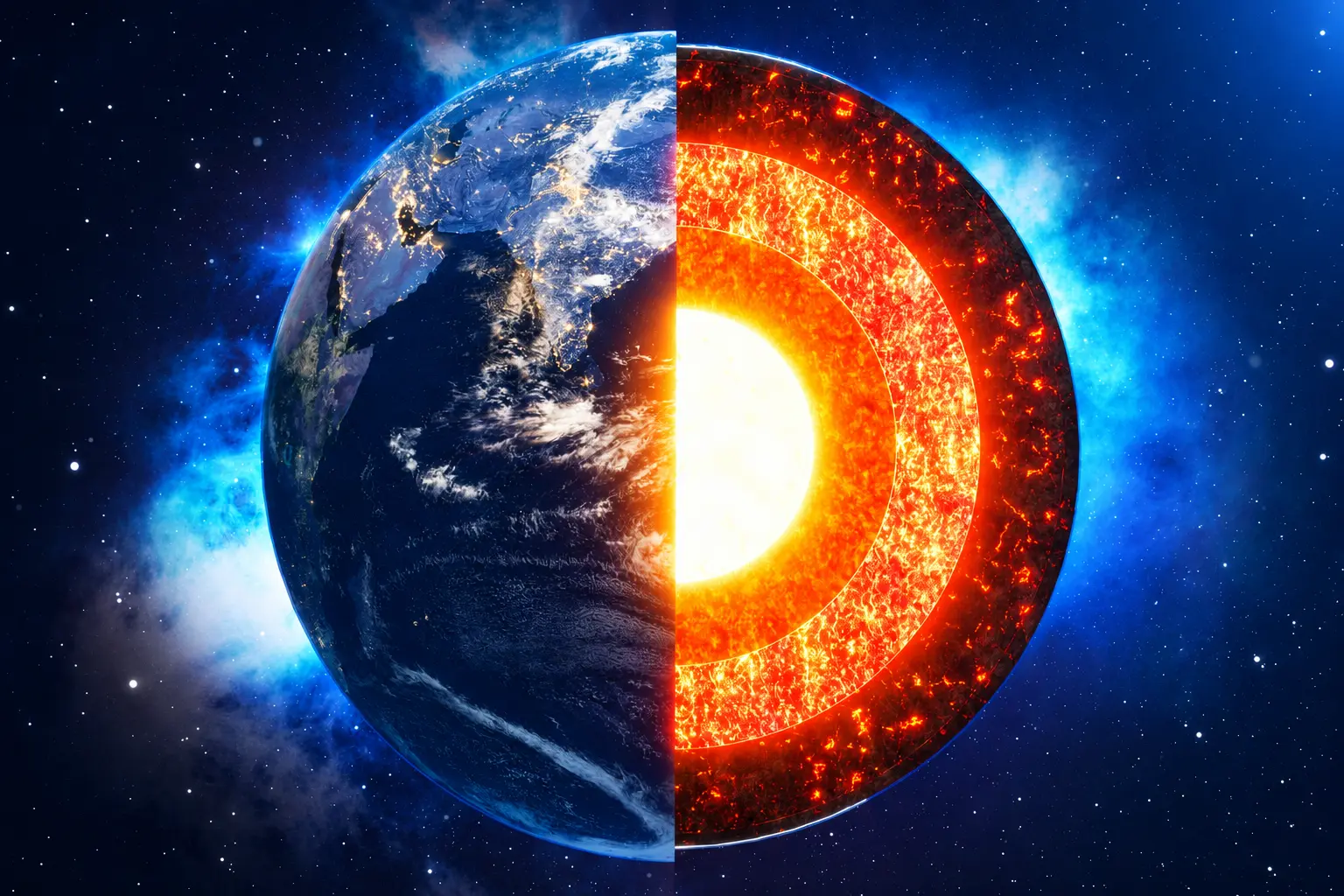
The Earth's internal structure
The crust
The outermost layer, where we live.
- According to NASA, about 31 km deep on average on land.
- About 5 km at the ocean bottom.
The mantle
The hot rock layer beneath the crust.
- About 2,900 km thick.
- It makes up most of the planet's volume.
- Its material can flow very slowly over geological time.
The outer core
- About 2,250 km thick.
- Composed mainly of molten iron and nickel.
- USGS presumes the outer core to be liquid, because it does not transmit S waves and because the velocity of P waves passing through it is sharply reduced.
The inner core
- A radius of about 1,221 km (NASA).
- Composed mainly of iron and nickel.
- USGS considers the inner core to be solid, because of the behaviour of both P and S waves passing through it.
How hot is it?
The temperature at the inner core boundary is only expected to be close to the melting point of iron at 330 GPa. Anzellini and colleagues (2013) compressed iron up to 200 GPa and then extrapolated, concluding that this melting temperature is 6,230 ± 500 K — a figure for pure iron, not a measured core temperature. The paper itself notes that as of 2013 there was "little consensus" on how iron melts at that pressure.
The pressure at that depth raises the melting point of iron above the temperature actually reached there — so the inner core is still considered to be solid.
What creates Earth's magnetic field?
Nearly all of Earth's magnetic field originates in the fluid outer core, where currents of molten iron and nickel convect continuously.
As the Earth rotates, these flows of electrically conducting metal generate enormous electrical currents, which in turn produce the magnetic field surrounding the planet. This mechanism is known as the geodynamo.
That field creates the magnetosphere, which NASA describes as shielding the planet from harmful solar and cosmic particle radiation.
🌍 Even without reaching it directly, scientists have built a fairly detailed picture of the Earth's interior. Every earthquake not only shakes the surface but also helps reveal the secrets lying thousands of kilometres beneath our feet.
References
- [1]Melting of Iron at Earth's Inner Core Boundary Based on Fast X-ray Diffraction — S. Anzellini, A. Dewaele, M. Mezouar, P. Loubeyre, G. Morard — Science 340(6131), 464–466 (2013)
- [2]Preliminary reference Earth model — A. M. Dziewonski và D. L. Anderson — Physics of the Earth and Planetary Interiors 25(4), 297–356 (1981)
- [3]Seismic Shadow Zones: S wave shadow zone — IRIS / EarthScope Consortium
- [4]Seismic Shadow Zones: P wave — IRIS / EarthScope Consortium
- [5]Inside the Earth — This Dynamic Earth: The Story of Plate Tectonics — U.S. Geological Survey (USGS)
- [6]Earth's Magnetosphere: Protecting Our Planet from Harmful Space Energy — NASA Science
- [7]Layers of the Earth — IRIS / EarthScope Consortium
- [8]The Interior of the Earth (General Interest Publication) — U.S. Geological Survey (USGS) — Eugene C. Robertson
USGS / Wikimedia Commons — public domain


