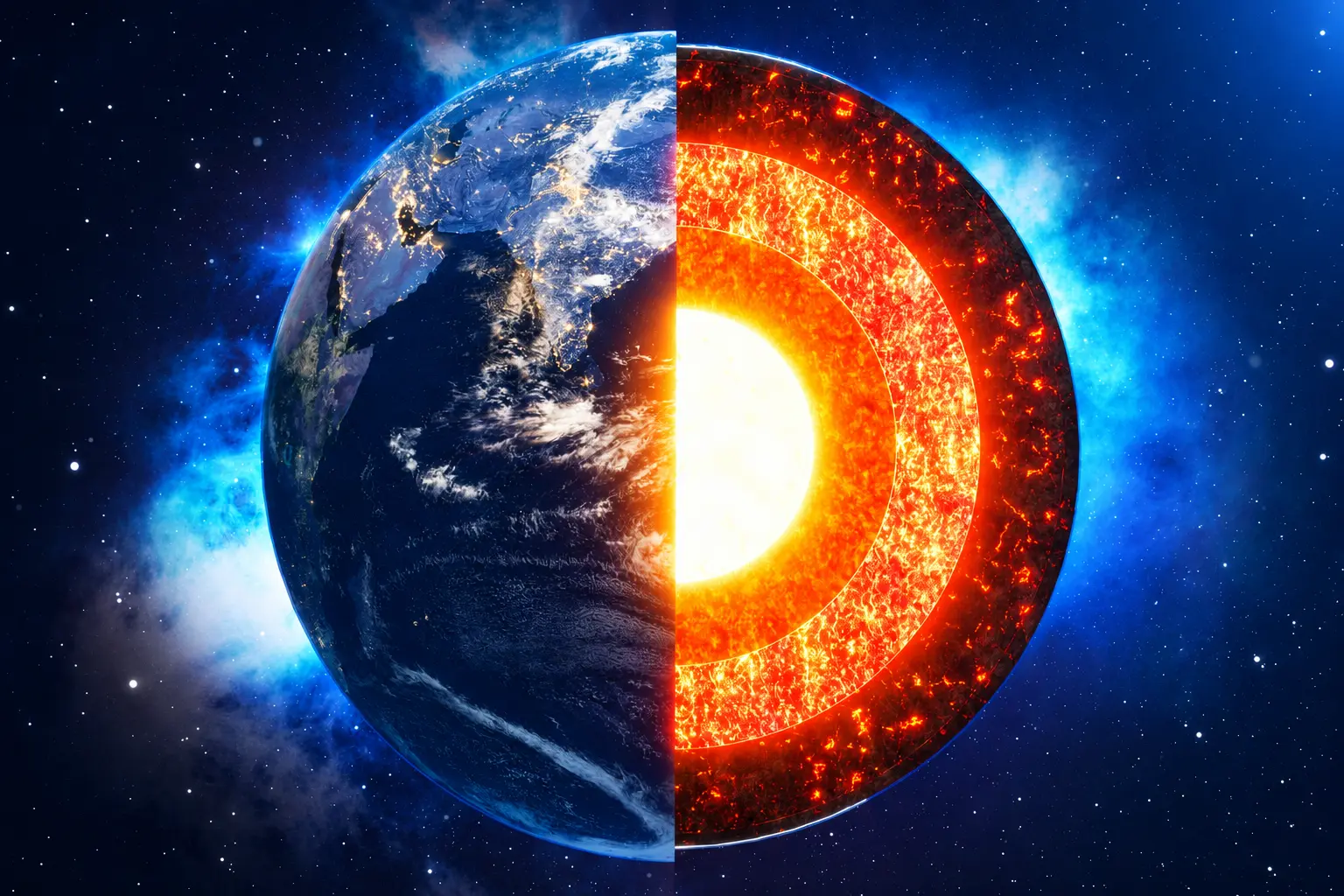
Gravity and magnetic fields are easily conflated because both are invisible and act at a distance. However, they originate from two completely different sources, and the consequences of that difference are far greater than many imagine.
Similarities
- Both act at a distance. No physical contact between objects is required.
- Both propagate as fields. Gravitational and magnetic fields fill the space around a source, and their disturbances travel at a speed not exceeding the speed of light.
- Both diminish with distance. The further from the source, the weaker the intensity.
Differences
| Gravity | Magnetic Field | |
|---|---|---|
| Source | Mass and energy | Moving electric charges |
| Conditions | Requires only mass | Requires electric current or ordered spin |
| Direction of force | Attractive only | Both attractive and repulsive, depending on poles |
| Relative strength | Weakest of the four fundamental forces | Dominates gravity at the particle scale |
| Shielding | Impossible | Possible, using magnetic materials |
| Distance decay | Inverse square of the distance | Faster — cube of the distance for a dipole |
The core difference lies in the first row. A rock, whether stationary or moving, hot or cold, will automatically generate gravity as long as it has mass. Conversely, a block of liquid metal, no matter how large, will not generate a magnetic field if the electric charges within it are not moving in a current.
This is why Earth and Jupiter have strong magnetic fields: their conductive fluid cores are in constant motion, maintaining a natural generator called a dynamo. It is also why Mars has almost completely lost its global magnetic field — its core has cooled, the dynamo shut down over 4 billion years ago, while its gravity has not gone anywhere.
Why Mars lost its atmosphere while Earth has not
This is where the difference between the two forces becomes very tangible.
Holding an atmosphere around a planet is the job of gravity. But the solar wind — a stream of charged particles emitted from the Sun at speeds of 400–800 km/s — does not steal the atmosphere by overcoming gravity. Instead, it erodes the atmosphere by transferring momentum to individual molecules in the upper layers, pushing them bit by bit past the escape velocity.
Earth's magnetic field stands as a shield against that stream of particles. Because the solar wind consists of charged particles, the magnetic field bends their trajectories and causes them to flow around the planet, forming a cavity known as the magnetosphere. Most of the particle stream is diverted around the planet rather than crashing directly into the atmosphere; the portion that enters along field lines at the poles creates the aurorae.
Mars no longer has that shield. NASA's MAVEN spacecraft has measured that the planet is still losing its atmosphere into space at this very moment, and the rate of loss spikes whenever there is a solar storm. The current surface pressure of Mars is less than 1% of Earth's.
Gravity holds the atmosphere down. The magnetic field keeps the solar wind from stripping it away. Losing either one is enough to leave a planet barren.
Further reading
References
- [1]MAVEN Mission — NASA (2024)
- [2]Earth Fact Sheet — NASA NSSDC (2024)
Image: NASA — Wikimedia Commons, Public domain.