Contents
- Formation: 4.54 billion years ago
- The moon-forming impact: approximately 4.5 billion years ago
- Oceans and the first cells: 4.4–3.5 billion years ago
- The Great Oxidation Event: approximately 2.4 billion years ago
- Snowball Earth: 720–635 million years ago
- Cambrian Explosion: 538 million years ago
- Moving onto land: 470–360 million years ago
- Two extinctions, two changes in leadership
- The road to humanity
- The true scale
- Further reading
Earth began as a sphere of molten rock, with no breathable atmosphere, no oceans, and nothing living on its surface. Four and a half billion years later, one of its products is reading this line.
This article covers the major milestones in chronological order. What is most remarkable is not each individual milestone, but the gaps between them: single-celled life occupied nearly the first three billion years, while all animals, plants, and humans are crammed into the final half-billion.
Formation: 4.54 billion years ago
Earth coalesced from a disk of dust and gas around the young Sun. The oldest samples—meteorites and zircon crystals in Western Australia dating back 4.4 billion years—allow this age to be determined with fair certainty.
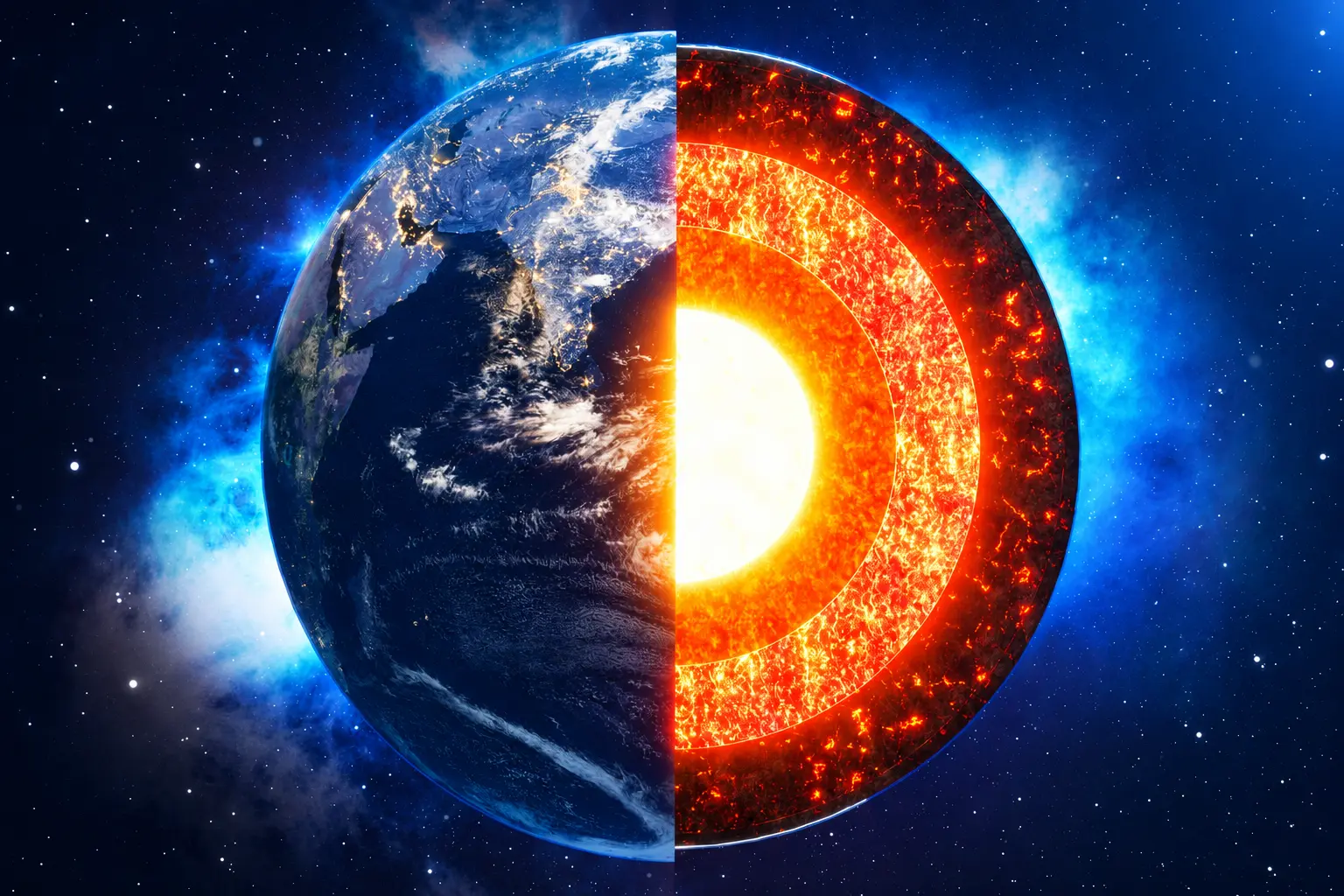
Initially, it was a molten planet. Heavy metals sank to the center to form the core, while lighter material rose to form the mantle and crust. That layered structure persists today, and it is the flow of electrically conductive liquid in the core that generates the magnetic field protecting our atmosphere.
The moon-forming impact: approximately 4.5 billion years ago
A Mars-sized celestial body, commonly referred to as Theia, collided with the young Earth. The ejected material coalesced to form the Moon.
The consequences have lasted until today. The Moon stabilizes Earth's axial tilt, preventing the climate from fluctuating chaotically over long cycles. Simultaneously, the tides it causes have gradually slowed the planet's rotation: the day on the early Earth lasted only a few hours, and it has since stretched to the 24 hours we have today.
Oceans and the first cells: 4.4–3.5 billion years ago
When the surface cooled enough for liquid water to exist, oceans formed. The source of the water comes from the very material that formed the planet plus contributions from colliding celestial bodies—the ratio between these two sources is still being debated.
The oldest widely accepted bacterial fossils are approximately 3.5 billion years old, and chemical traces of life may be even earlier. This means that life appeared quite rapidly after the planet became habitable—one of the reasons many scientists believe life may not be rare in the universe.
Stromatolites—layered rock structures created by microbial mats—are visible evidence of this period, and they are still forming in Shark Bay, Australia.
The Great Oxidation Event: approximately 2.4 billion years ago
Cyanobacteria learned how to photosynthesize and release oxygen. Initially, the oxygen was entirely absorbed by iron dissolved in the ocean, creating banded iron formations—the source of iron that most of the modern steel industry mines today.
When the iron was depleted, oxygen began to accumulate in the atmosphere. For most organisms at that time, oxygen was poisonous, and this event may have been the largest mass extinction to ever occur—it is just that the victims were all microorganisms, so they left no easily recognizable fossils.
Snowball Earth: 720–635 million years ago
During the Cryogenian period, ice spread to the tropics, potentially covering almost the entire planet. The mechanism was a self-amplifying loop: more ice meant more light reflection, which led to more cooling, which led to more ice.
What broke the loop were volcanoes. The ice cover caused rock weathering—which normally draws CO₂ from the atmosphere—to almost cease, while volcanoes continued to release CO₂. After millions of years, the greenhouse effect accumulated enough strength to melt the ice.
Cambrian Explosion: 538 million years ago
Over about 20–25 million years, almost all modern animal phyla appeared in the fossil record. This was the first time hard skeletons, eyes, and active predation existed—predator and prey began an evolutionary arms race, a selective pressure unlike any before.
Trilobites are the icon of this period, while the half-meter-long Anomalocaris was the apex predator.
Moving onto land: 470–360 million years ago
Plants moved onto land first, about 470 million years ago, and it took a long time for them to develop vascular tissue to grow tall. Arthropods followed.
Four-limbed vertebrates—tetrapods—appeared at the end of the Devonian period, about 375–360 million years ago, evolving from lobe-finned fish. Tiktaalik and Ichthyostega are the most famous transitional forms. Note that tetrapods are an entire branch of organisms, not a single species.
The subsequent Carboniferous period left two legacies: modern coal deposits and the amniotic egg—the advancement that allowed reptiles to lay eggs on land without needing to return to the water.
Two extinctions, two changes in leadership
252 million years ago, the Permian mass extinction wiped out about 80% of marine species and paved the way for the archosaurs.
66 million years ago, an asteroid approximately 10 km in diameter struck what is now the Yucatán Peninsula, leaving the Chicxulub crater. Dust and sulfates blocked the Sun for years, and the food chain collapsed. Every non-avian dinosaur disappeared; volcanic activity from the Deccan Traps during the same period may have already weakened the ecosystem beforehand.
Mammals survived by being small, omnivorous, and capable of burrowing.
The road to humanity
After the extinction, mammals radiated to fill every empty ecological niche. Primates appeared about 55 million years ago with the characteristics that defined the entire branch: opposable thumbs for grasping and forward-facing eyes for stereoscopic vision.
The Laetoli footprints in Tanzania, approximately 3.66 million years old, are the earliest direct evidence of bipedalism, belonging to the genus Australopithecus.
Homo erectus appeared about 1.9 million years ago and was the first human species to leave Africa. Homo sapiens appeared about 300,000 years ago—fossils at Jebel Irhoud, Morocco, have pushed this date much further back than the 100,000-year figure once commonly used.
Agriculture began about 12,000 years ago, when the last ice age ended. The entire written history of humanity is contained within about 5,000 years.
The true scale
If we compress 4.54 billion years into a single calendar year:
| Event | Time in the "year" |
|---|---|
| Earth formation | January 1 |
| First cells | End of February |
| Oxygen accumulates in the atmosphere | End of July |
| Multicellular animals | Mid-November |
| Cambrian explosion | November 19 |
| Dinosaur extinction | December 26 |
| Homo sapiens | 23:37, December 31 |
| Entire written history | Last 30 seconds |
Single-celled life occupied nearly the first three billion years. If there is life out there, the highest probability is that we will find it in bacterial form, not as a form capable of responding to signals.
Adapted from the article Hình thành và tiến hóa của sự sống trên Trái Đất by Đặng Vũ Tuấn Sơn, published by the Vietnam Astronomy Society (VACA). Original content copyright belongs to VACA.
Further reading
References
- [1]Hình thành và tiến hóa của sự sống trên Trái Đất — Thiên văn Việt Nam (VACA) — Đặng Vũ Tuấn Sơn (2011)
Image: Paul Harrison — Wikimedia Commons, CC BY-SA 3.0.