Contents
A Common Starting Point
In 1916, Karl Schwarzschild found the first solution to Einstein's field equations.
This solution describes an object with gravity so strong that an event horizon appears, a boundary from which nothing can escape. This is the theoretical foundation of black holes.
From the same set of equations, physicists also found other exotic solutions, including white holes and wormholes.
What is a white hole?
A white hole can be seen as the "time-reversed version" of a black hole.
- Black holes let matter in but do not let it out.
- White holes let matter out but do not let it in.
However, a white hole does not push objects out using anti-gravity. It still has mass and still attracts surrounding objects.
Why are white holes unlikely to exist?
There are two major problems:
- They seem to go against the direction of increasing entropy in nature.
- They are highly unstable; even a small amount of matter falling in could cause them to collapse into a black hole.
Therefore, most physicists believe that if white holes ever existed, they would be unlikely to last long in the real universe.
What is a wormhole?
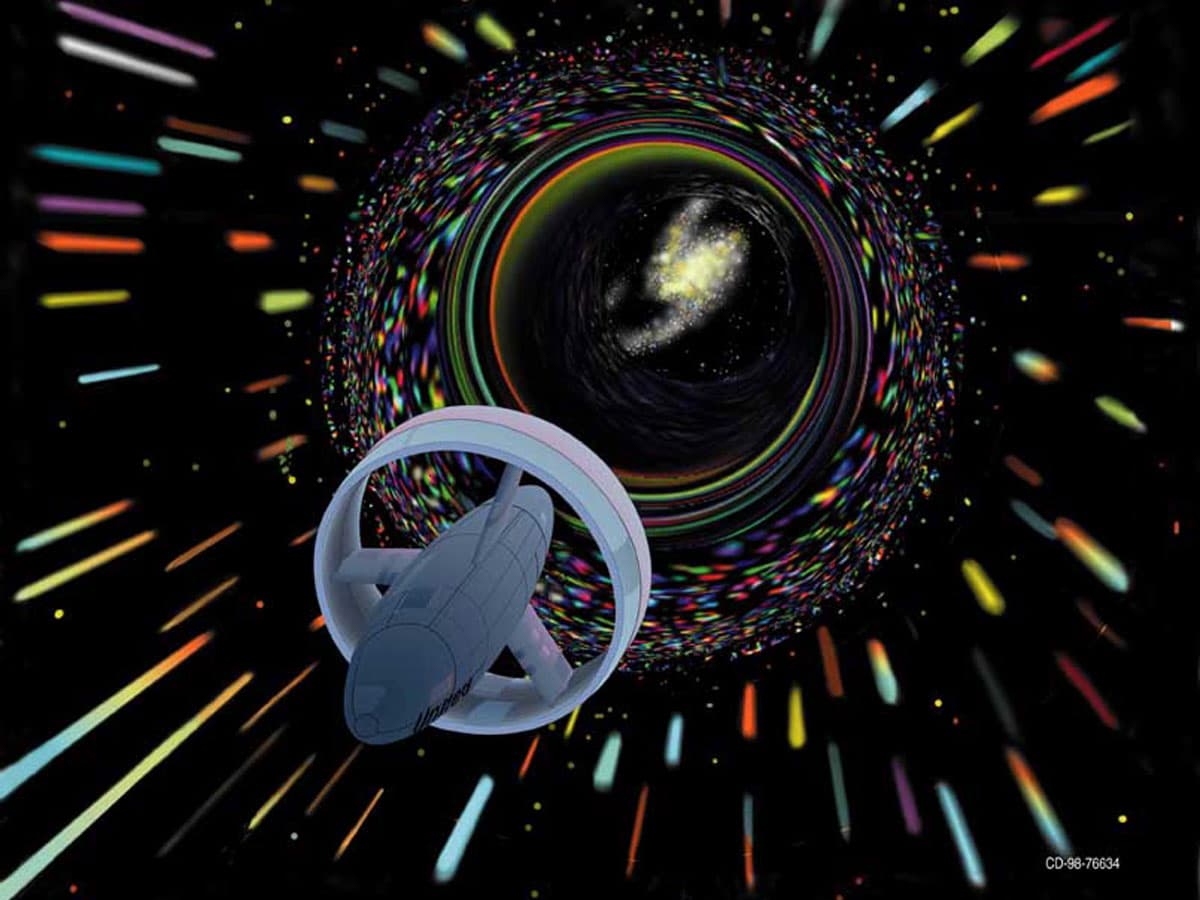
A wormhole is a "tunnel" connecting two different regions of space-time.
This idea appeared in the work of Einstein and Rosen in 1935, so it is sometimes called an Einstein–Rosen bridge.
A simple way to visualize it is:
- Following the normal path requires crossing the entire distance.
- A wormhole is a shortcut connecting two distant points.
Can you travel through a wormhole?
According to the original Einstein–Rosen solution:
No.
The tunnel would collapse too quickly before any object or light could pass through.
To keep a wormhole open longer, theoretical models require a special type of matter with negative energy density, often called exotic matter.
To date:
- This type of matter has never been detected on the necessary scale.
- There is no observational evidence for wormholes.
Why do physicists still study them?
Although not yet discovered, white holes and wormholes still have scientific value because:
- They help test the limits of general relativity.
- They relate to deep questions about black holes and quantum information.
- They may provide clues for a unified theory between gravity and quantum mechanics.
How do they differ from black holes?
| Object | Observational evidence |
|---|---|
| Black hole | Yes |
| White hole | None yet |
| Wormhole | None yet |
Meanwhile, black holes have been confirmed in several ways:
- Detection of gravitational waves from black hole mergers (2015).
- Image of the M87* black hole (2019).
- Image of Sagittarius A* at the center of the Milky Way (2022).
Conclusion
White holes and wormholes are both mathematically valid solutions of general relativity. However, unlike black holes, they have never been observed in nature, and there are currently many physical obstacles making them unlikely to appear in the universe we observe.
🕳️ In short: black holes have stepped out of equations to become real astronomical objects; white holes and wormholes remain within the realm of theory and hypothesis.
Read more
References
- [1]Lỗ đen, lỗ trắng và lỗ sâu — Thiên văn Việt Nam (VACA) — Đặng Vũ Tuấn Sơn (2012)
Artist's concept by Les Bossinas (Cortez III Service Corp.) for NASA, 1998 — public domain