Contents
Viewed from Earth, the Sun rises in the east and sets in the west, as do the stars. The most natural explanation was that Earth stands still in the center—the geocentric model that Ptolemy perfected and maintained for over 1,400 years.
In 1543, Copernicus placed the Sun at the center. But he still retained an ancient assumption: orbits had to be circular, because the circle is a perfect shape. By keeping that assumption, his model still had to rely on epicycles to match observations, and its accuracy was not much better than Ptolemy's.
The person who broke the deadlock was Johannes Kepler, and his tool was data.
Tycho Brahe's Data
Tycho Brahe spent more than twenty years measuring planetary positions with the naked eye using large instruments, achieving an error margin of about 1–2 arcminutes—ten times more accurate than Ptolemy's star catalog. Kepler was assigned to process the data on Mars after Brahe died in 1601.
He spent years trying to fit a circular orbit. The best model he could construct was still off by 8 arcminutes from observations. With less precise data, 8 arcminutes would have been negligible. With Brahe's data, it was not.
Kepler refused to ignore it. He wrote that those very 8 arcminutes led to the reform of all astronomy.
First Law—Orbits Are Ellipses
Every planet moves on an ellipse, with the Sun located at one focus.
Note: The Sun is at a focus, not at the center of the ellipse. The other focus is empty.
Why an ellipse and not a circle? The answer came from Newton 78 years later: with an attractive force inversely proportional to the square of the distance, all closed orbits are ellipses. A circle is merely a special case—it requires the velocity to have one exact, single value, directed perfectly perpendicular to the line connecting the centers. Deviate even slightly, and the orbit becomes an ellipse.
In other words, the ellipse is the general case, while the circle is the exception, and there is no reason for nature to choose that precise exception.
The flatness of an ellipse is called its eccentricity. The orbits of the planets are quite nearly circular—Earth has an eccentricity of 0.017, so its distance to the Sun changes by only about 3% during the year. Comets are the opposite: Halley's Comet has an eccentricity of 0.967.
Second Law—The Law of Equal Areas
A line segment connecting the Sun to a planet sweeps out equal areas in equal intervals of time.
Consequence: A planet moves faster when close to the Sun and slower when far away. Earth moves fastest in early January when at perihelion, and slowest in early July.
This is precisely why the seasons in the Northern Hemisphere are not equal in length: Northern Hemisphere winter is several days shorter than summer because Earth moves through that part of its orbit faster.
Today, this law is understood as a form of conservation of angular momentum—an inevitable consequence when the force is always directed toward a fixed point.
Third Law—Periods and Distances
The square of the orbital period is proportional to the cube of the semi-major axis.
The most convenient form uses Earth as a reference: with period P measured in years and semi-major axis a measured in AU,
P² = a³
Let's try Jupiter: a = 5.203 AU, so a³ ≈ 140.9, and P = √140.9 ≈ 11.9 years. The actual value is 11.86 years.
| Planet | a (AU) | Calculated P | Actual P |
|---|---|---|---|
| Mercury | 0.387 | 0.241 years | 0.241 |
| Venus | 0.723 | 0.615 | 0.615 |
| Mars | 1.524 | 1.881 | 1.881 |
| Jupiter | 5.203 | 11.87 | 11.86 |
| Saturn | 9.537 | 29.45 | 29.45 |
| Uranus | 19.19 | 84.06 | 84.02 |
| Neptune | 30.07 | 164.9 | 164.8 |
The full form, derived by Newton, is
P² = 4π²a³ / [G(M + m)]
where M is the mass of the parent star and m is the mass of the planet. Because m is thousands to millions of times smaller than M, neglecting it changes the result hardly at all—which is why the simplified form P² = a³ works so well.
But the full form is the one that is truly useful: it allows us to weigh the mass of a distant celestial body. By measuring the period and distance of a satellite, we can deduce the mass of the planet it orbits. This remains the primary method for determining the mass of distant celestial bodies.
A Common Misconception
Many sources explain orbits by stating that gravity and centrifugal force balance each other out, which is why a planet neither falls into the Sun nor flies off.
This formulation is misleading. In an inertial frame of reference, there is only one force acting on the planet: gravity. It is not balanced by anything—it continuously accelerates the planet toward the Sun. The planet does not fall in because it has sideways motion, so its path curves just enough that it keeps "missing" forever.
"Centrifugal force" exists only when we choose a reference frame rotating with the planet. It is a valid computational tool, but using it to explain why the planet does not fall obscures the true nature of the phenomenon.
Kepler's three laws describe motion very accurately, but they could not explain why. He knew what the planets were doing, but not why. It was not until 1687 that Newton showed all three were consequences of a single law of gravitation—transforming three rules of planets into three rules for all objects with mass.
Adapted from the article Nguyên lý chuyển động của các hành tinh by Toàn Ngọc Ánh, published on Vietnam Astronomy (VACA). Copyright of the original content belongs to VACA.
References
- [1]Three editions of the star catalogue of Tycho Brahe — Astronomy & Astrophysics (2010)
- [2]Earth's Seasons — Equinoxes, Solstices, Perihelion, and Aphelion — U.S. Naval Observatory
- [3]Orbits and Kepler's Laws — NASA Science (2024)
- [4]1P/Halley — NASA Science (2024)
- [5]Planetary Physical Parameters — NASA JPL — Solar System Dynamics (2019)
- [6]Approximate Positions of the Planets — NASA JPL — Solar System Dynamics (1992)
- [7]Nguyên lý chuyển động của các hành tinh — Thiên văn Việt Nam (VACA) — Toàn Ngọc Ánh (2015)
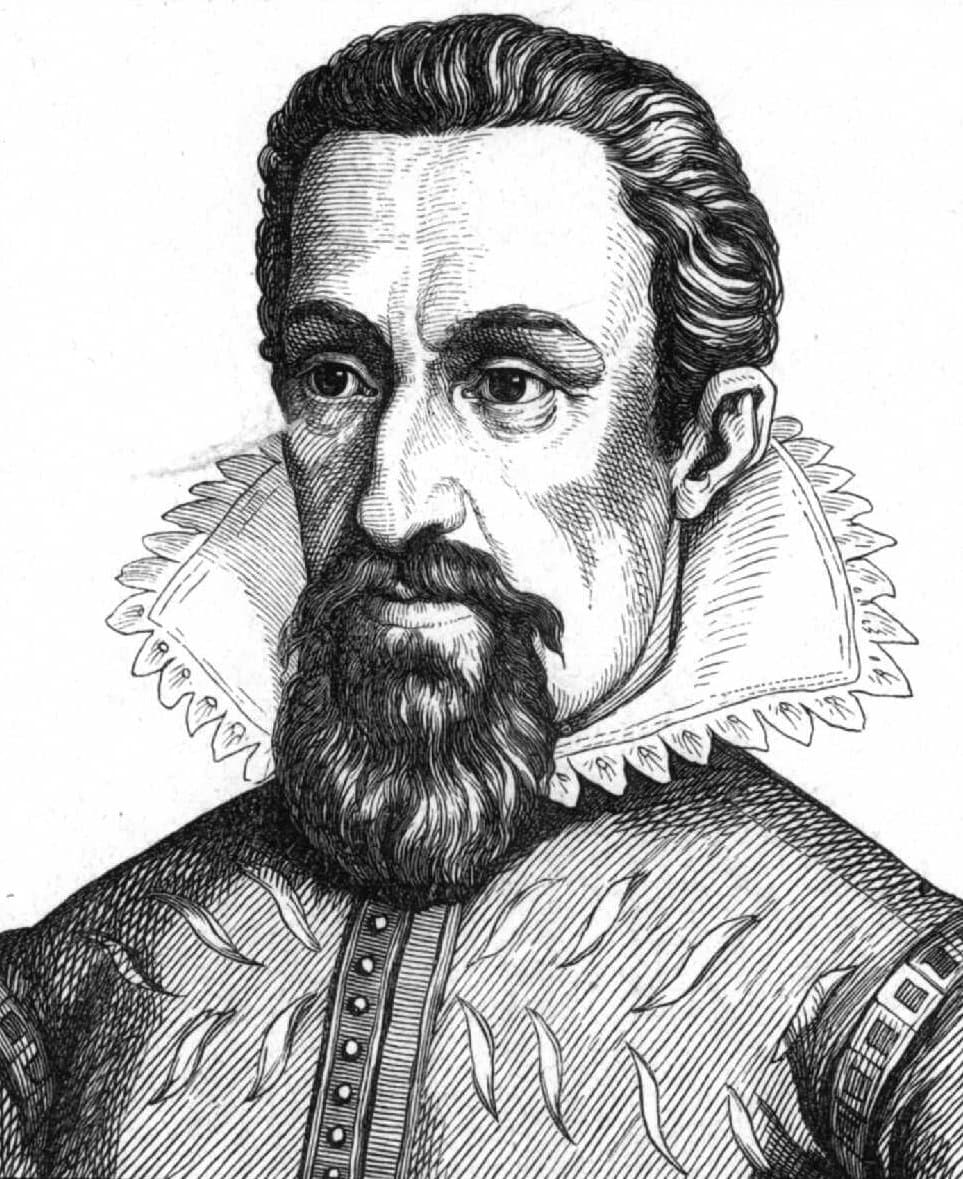
Portrait of Johannes Kepler, 1610 — public domain